Monday, March 28, 2011

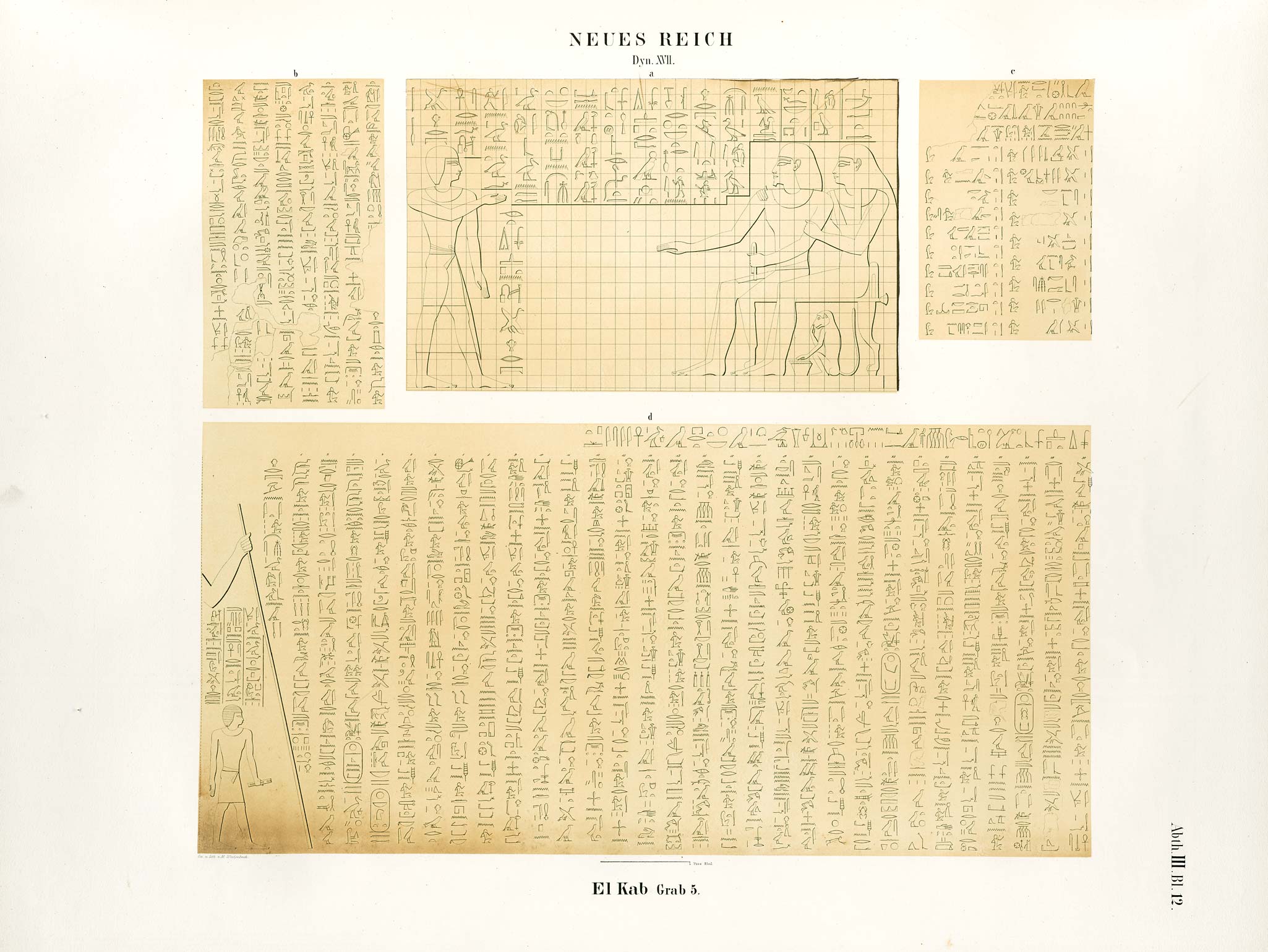
El-Kab The tomb of ahmos, Biografía del Almirante Ahmose, El Hijo de Abana Biography of Admiral Ahmose, The Son of Abana

del Almirante Ahmose, El Hijo de Abana

Biography of Biografía Admiral Ahmose, The Son of Abana


Presentación

Vista general de la necrópolis de el-Kab
En la primera parte de la narración, el Almirante (quien está sobre la marinería) Ahmose hace un resumen de sus condecoraciones y ensalza el valor perdurable de la fama.
In the first part of the story, the Admiral (who is on the seamanship) Ahmose does a summary of his decorations and extolls the lasting value of the reputation
Hr(y) Xnyt iaH-ms sA ibAnA mAa-xrw
El Almirante Ahmose, el hijo de Abana, justificado,
 Admiral Ahmose, the son of Abana, justified,
Dd.f Dd.i n.tn rmT nbt
dice: ‘Os hablo a vosotros, a toda la gente.
 he says: ' I speak to you, to all the people.
d.i rx.tn Hswt xpr(w)t n.f
Voy a hacer que conozcáis las cosas favorables que me ocurrieron:
 I am going to do that you know the favorable things that happened to me:
iwa.kwi m nbw sp 7 xft-Hr-n tA r-Dr.f Hmw Hmwt r-mitt iry
Fui recompensado con oro en 7 ocasiones delante de la tierra entera, (con) siervos y siervas del mismo modo,
I was rewarded by gold in 7 occasions in front of the entire ground, (by) serfs and serfs in the same way,
sAH.kwi m AHwt aSAw(t) wrt
y dotado con numerosísimos campos. ,
 and provided with the most numerous fields.
iw rn n qn m irt.n.f nn Htm.(w) m tA pn Dt
El nombre del valiente (la fama) es según lo que ha hecho no pereciendo en esta tierra nunca’.
The name of the brave one (the reputation) is according to what it has done never perishing in this ground ’.


Juventud de Ahmose
Describe el lugar de su infancia, Nejeb durante el reinado de Tao Seqenenra y sus primeras peripecias como soldado bajo el mando de Ahmose, primer faraón de la Dinastía XVIII.
Nos llama la atención la falta de referencias biográficas durante las primeras incursiones de Kamose contra el invasor hickso, periodo en el cual debió fallecer su padre Baba. Youth of Ahmose (Urk IV 2,8 - 2,16)
 [To return to the index]
 It describes the place of his infancy, Nejeb during the reign of Tao Seqenenra and his first fortunes as soldier under the control of Ahmose, the first Pharaoh of the Dynasty XVIII.
 The absence of biographical references attracts attention of us during the first incursions of Kamose against the invader hickso, period in which his father Baba should have died.
Dd.f r-ntt ir.n.i xprw.i m dmi n nxb
iw it.i m waw n nsw-bit sqnn-ra maA-xrw bAbA sA r-int rn.f
Dice que: ‘He desarrollado (lit.: he hecho mis transformaciones) en la ciudad de Nejeb (el-Kab) cuando mi padre era soldado del rey del Alto y Bajo Egipto Seqenenra, justificado, cuyo nombre era Baba, el hijo de Reinet.
 He says that: ' I have developed (lit.: I have done my transformations) in the city of Nejeb (the-Kab) when my father was welded of the king of the High place and Under Egypt Seqenenra, justified, whose name was a Saliva, the son of Reinet.
aHa.n.i Hr irt waw r-DbA.f m pA dpt n(t) pA smA
m-hAw nb tAwy np-pHtt-ra mAa-xrw iw.i m Sri n irt.i Hmt
iw sDr.i m smt Snw
Luego, estuve ejerciendo de soldado sustituyéndolo en el barco ‘El Toro Salvaje’ en época del señor de las Dos Tierras Nebpehetetra, justificado, siendo aún un muchacho, antes de tener esposa, cuando dormía en una hamaca de redes.
Then, I was a soldier replacing it in the ship ‘ The Wild Bull ’ in epoch of the master of Two Earths Nebpehetetra, justified, being still a boy, before having wife, when he was sleeping in a hammock of networks


Expulsión de los hicksos
Ahmose se hace mayor y funda un hogar. Acompaña a su majestad, el rey Ahmose en sus campañas navales contra los invasores asiáticos y en el sitio de Avaris, la capital hicksa. En varias ocasiones es recompensado con el oro del valor tras haber mostrado su valentía y presentado las correspondientes manos de los enemigos de Egipto. Expulsion of the hicksos (Urk IV 3,2 - 5,2)

 Ahmose becomes major and founds a hearth. He accompanies his majestad, king Ahmose in his naval campaigns against the Asian invaders and in the place of Avaris, the capital hicksa. In several occasions it is rewarded by the gold of the value after having showed his valor and presented the correspondents hands of the enemies of Egypt.
xr m-xt grg.n.i pr
Con posterioridad fundé una casa.
aHa.n.i iT.kwi r pA dpt mHty Hr qnn.i
wn.xr.i Hr Sms ity anx wDA snb Hr rdwy.i m-xt swtwt.f Hr wr(ry)t.f
iw Hms.tw Hr dmi n Hwt-wart
wn.xr.i Hr qnt Hr rdwy.i m-bAH Hm.f
Luego, tomé posesión en el barco ‘El Norteño’ por mi supremacía, así pude ir acompañando al soberano (v.p.s.) a pie siguiendo sus paseos en su carro, cuando se ponía sitio a la ciudad de Hutuaret (Avaris) y así pude ser valeroso a pie en presencia de su majestad.
 Then, I took possession in the ship ‘ The Northerner ’ for my supremacy, this way I could be accompanying the sovereign one (v.p.s.) on foot following his walks in his car, when it was putting itself on place to the city of Hutuaret (Avaris) and this way I could be courageous on foot in the presence of his majestad.
aHa.n.i dhn.kwi r xa-m-mn-nfr
Luego, fui promocionado al barco ‘Jaemmennefer (quien aparece en Menfis)’.
Then, I was promoted to the ship ‘ Jaemmennefer (who appears in Menfis) ’.
wn.in.tw Hr aHA Hr mw m pA Ddkw n Hwt-wart
Así se estuvo combatiendo en el canal de Hutuaret.
 This way it was fighting in the channel of Hutuaret.
aHa.n xAfa.n.i in.i Drt
Entonces hice una captura y traje una mano.
Then I did an apprehension and brought a hand.
smi.T(w) n wHmw-nsw wn.in.tw Hr rdt n.i nbw n qnt
Una vez se informó al heraldo real, se me concede el oro del valor.
 Once the real herald was informed, the gold of the value is granted to me.
aHa.n wHmw aHA m st tn wn.in.i Hr wHm xAfa im in.i Drt
wn.in.tw Hr rdt n.i nbw n qnt m wHm-a 
Luego, de nuevo, se combatió en este lugar y, de nuevo, hago una captura allí y traje una mano, y se me concede el oro del valor otra vez.
Then, again, it fought in this place and, again, I do an apprehension there and I brought a hand, and the gold of the value is granted to me again.
wn.in.tw Hr aHA m tA kmt rsy n dmi pn
A continuación se combate en la tierra de Egipto, al sur de esta ciudad
 Next it fights in the ground of Egypt, to the south of this city
aHa.n in.n.i sqr-anx s hA.n.i r pA mw
mk in.tw.f m mH Hr tA wAt pA dmi DA.n.i Xr.f Hr mw
Luego, traje un prisionero, un hombre, después de bajar al agua. Mira, fue traído como capturado en el camino de la ciudad después de cruzar cargándolo por el agua.
Then, I brought a prisoner, a man, after going down to the water. It looks, it was brought like captured in the way of the city after crossing loading it for the water.
smi.T(w) n wHmw-nsw aHa.n.tw mk iwa.i nbw n qnt Hr sn-nw sy
Una vez se informó al heraldo real, se me concedió el oro del valor una vez más.
 Once one informed the real herald, the gold of the value was granted to me once again.
wn.in.tw Hr HAq Hwt-wart wn.in.i Hr int HAqt im s 1 st-Hmt 3 dmD r tp 4
wn.in Hm.f Hr rdt st n.i r Hmw
A continuación se saquea Hutauret (Avaris), traigo botín de allí, 1 hombre y 3 esclavas, en total, 4 personas, y su majestad me los dio como sirvientes.
 Next Hutauret (Avaris) is plundered, I bring booty of there, 1 man and 3 slaves, in whole, 4 persons, and his majestad gave them to me as servants.
wn.in.tw Hr Hmst Hr SA-r-HA-nA m rnpwt 6
wn.in.tw Hr HAq.s
Luego se puso sitio a Sharhana durante 6 años y, luego, su majestad la saquea
Then it put itself I besiege Sharhana for 6 years and, then, his majestad plunders it..
aHa.n in.n.i HAqt im st-Hmt 2 Drt
wn.in.tw Hr rdt n.i nbw n qnt mk rd.t(w) n.i HAqt.i r Hmw
Entonces traje botín de allí, 2 mujeres y una mano. Así que se me concede el oro del valor. Mira, se me dio mi botín como sirvientes.
 Of that time I brought booty of there, 2 women and a hand. So the gold of the value is granted to me. Sight, one gave me my booty as servants.


Campaña nubia de Ahmose
Tras la incursión meridional para expulsar a los invasores hicksos del norte del país, el faraón Ahmose inicia una campaña contra los aliados del invasor, los nubios del sur. Campaign nubia of Ahmose

 After the southern incursion to expel the invaders hicksos from the north of the country, the Pharaoh Ahmose initiates a campaign against the Allied Forces of the invader, the nubios of the south
xr m-xt smA.n Hm.f mntyw sTt
wn.in.f Hr xntyt r xnt-Hn-nfr r sksk iwntyw styw
wn.in Hm.f Hr irt Xat aAt im.sn
Y después que su majestad aniquiló a los beduinos de Asia, navega río arriba hacia Jenethennefer (Nubia) para destruir a los nómadas nubios, y su majestad hace un abundante número de cadáveres con ellos.
And later that his majestad annihilated the Bedouins of Asia, it sails upstream towards Jenethennefer (Nubia) to destroy the nomads nubios, and his majestad does an abundant number of corpses with them.
aHa.n in.n.i HAqt im s 2 anx Drt 3 wn.in.tw Hr iwa.i m nbw Hr sn-nw sy
mk rd.t(w) n.i Hmt 2
Entonces traje botín de allí, 2 hombres vivos y 3 manos, y se me recompensa con oro una vez más. Mira, se me dieron 2 sirvientas.
Of that time I brought booty of there, 2 alive men and 3 hands, and I reward with gold once again. Sight, 2 servants happened to me.
nat m xd in Hm.f ib.f Aw.(w) m qnt nxt
iT.n.f rsyw mHtyw
Su majestad navegó río abajo con su corazón dilatado por el valor y la victoria después de conquistar a los habitantes del sur y los del norte.
His majestad sailed downstream with his heart dilated by the value and the victory after conquering the southerners and those of the north.


La rebelión de Aata
El rebelde Aata y sus tropas son atacadas y destruidas por Ahmose, a quien se conceden varios sirvientes y 5 aruras de tierra en la ciudad que lo vio nacer.
 The rebel Aata and his troops are attacked and destroyed by Ahmose, to whom several servants and 5 are granted aruras of ground in the city that saw it being born.
aHa.n AAtA iw.(w) n rsy stkn Saw.f m(w)t.f
nTrw SmAw Hr Am.f gm.t(w).f in Hm.f m ti-nt-tA-a
Entonces Aata vino del sur – su destino acarreaba su muerte -, pues los dioses del Alto Egipto lo sujetaban cuando fue encontrado por su majestad en el canal de Tinettaa.
Of that time Aata came from the south – his destination was transporting his death-, since the gods of the High Egypt were holding it when it was found by his majestad in the channel of Tinettaa.
wn.in Hm.f Ht intw.f m sqr-anx rmT.f nb(t) m is-HAq
Así que su majestad lo trajo como cautivo  y su gente como una presa fácil.
So his majestad brought it like I captivate and his people as an easy prey.
aHa.n in.n.i m(a)gA 2 m mH m pA dpt n AAtA
wn.in.tw Hr rdt n.i tp 5 Hr dniw Aht stAt 5 m niwt.i
irw n tA Xnyt r-Aw.s m-mitt
Entonces traje 2 reclutas capturados en el barco de Aata y se me dan 5 personas y una parcela de campo de 5 aruras en mi ciudad. Se hizo para toda la marinería del mismo modo.
Suit of that time 2 recruits captured in the ship of Aata and they give me 5 persons and a field plot of 5 aruras in my city. It did for the whole seamanship in the same way.


La rebelión de Tetian

Plano de la tumba de Ahmose, el hijo de Abana, en el-Kab

Es ahora Tetian, quien incordia a Ahmose y se encuentra con un castigo similar.
It is now Tetian, who incordia to Ahmose and he meets a similar punishment.
aHa.n xr(w) pf iw.(w) ttian rn.f sHwy.n.f n.f Xakw-ib
Luego ese enemigo, cuyo nombre era Tetian, vino después de reunir para sí a los descontentos.
Then this enemy, whose name was Tetian, wine after assembling for yes to the dissatisfactions.
wn.in Hm.f Hr smA.f iswt.f m tmt xpr
Así que su majestad lo mata y fue su tropa como los que nunca existieron.
So his majestad kills it and it was his troop as those who never existed.
aHa.n rd.n.i tp 3 Aht sTAt 5 m niwt.i
Entonces se me dieron 3 personas y 5 aruras de tierra en mi ciudad
Then they gave me 3 persons and 5 aruras of ground in my city


Campañas nubias de Amenhotep I

Una c las peripecias del marinero con el rey Ahmose, y una vez muerto el monarca, inicia sus aventuras con Amenhotep I.
One c the fortunes of the sailor with king Ahmose, and as soon as it be died the monarch, it initiates his adventures with Amenhotep I.
wn.in.i Hr Xnt nsw-bit Dsr-kA-ra mAa-xrw iw.f m xntyt r k(A)S 
r swsx tASw kmt
Estuve transportando por agua al rey del Alto y Bajo Egipto Dyeserkara cuando navegaba río arriba hacia Kush para ensanchar las fronteras de Egipto.
I was transporting for water the king of the High place and Under Egypt Dyeserkara when I was sailing upstream towards Kush to expand the borders of Egypt.
wn.in Hm.f Hr sqr iwnty  pf m-Hr-ib mSa.f inw m gwAgwA
nn nhw.sn wtxw m dy Hr gs mi iwtyw xpr.(w)
ist wi m tp n mSa.n
Así que su majestad derriba a ese jefe nativo en medio de su ejército, el que fue traído con grilletes sin que pudieran escapar, y los que huían fueron derribados de lado como quienes nunca existieron, mientras estaba a la cabeza de nuestro ejército.
 So his majestad knocks down this native boss in the middle of his army, which was brought by shackles without they could escape, and those who were fleeing they were knocked down of side as whom they never existed, while it was at the head of our army.
iw aHA.n.i r-wn-mAa mAn Hm.f qnt.i in.i Drt 2
ms n Hm.f
He combatido con mucha acción y su majestad pudo ver mi valentía cuando traje 2 manos que ofrecieron a su majestad.
I have fought with great action and his majestad could see my valor when I brought 2 hands that offered his majestad.
wn.in.tw Hr HHy rmT.f mnmnt.f
Se estuvo buscando a su gente y a sus rebaños.
There for were looked his people and to his herds.
aHa.n in.n.i sqr-anx ms n Hm.f
Luego traje un prisionero que fue ofrecido a su majestad.
Then I brought a prisoner who was offered to his majestad.
in.i Hm.f r hrw 2 r kmt m Xnmt Hrw
Fui capaz de llevar a su majestad en dos días a Egipto desde la cisterna superior.
 I was capable of taking his majestad in two days to Egypt from the top cistern.
aHa.n.tw Hr iwa.i n nbw
Entonces se me recompensa con oro.
Then I reward with gold.
aHa.n in.n.i Hmt 2 m HAq Hrw-(r) nn n ms.n.i n Hm.f
wn.in.tw Hr rdt.i r aHAwty n HqA
Luego traje dos sirvientas como botín además de aquellas  que había ofrecido a su majestad, así que se me concede (el título) de guerrero de mando.
Then I brought two servants as booty in addition to those that it had offered to his majestad, so there is granted to me (the title) of warrior of control.


Campañas nubias de Thutmose I

A la muerte de Amenhotep I, le sucede en el trono su hijo Thutmose I (Aajeperkara) quien continua luchando contra las insurrecciones nubias.
To the death of Amenhotep I, there happens to him in the throne his son Thutmose I (Aajeperkara) who keeps on fighting against the insurrections nubias.
 
wn.in.i Hr Xnt nsw-bit aA-xpr-kA-ra iw.f m xntyt r xnt-Hn-nfr
r sswn HAay xt xAswt r dr bs n a-xAst
Estuve transportando por agua al rey del Alto y Bajo Egipto Aajeperkara cuando navegaba río arriba hacia Jenethennefer para sofocar una insurrección a través de los países extranjeros y para suprimir el influjo de la región desértica.
 I was transporting for water the king of the High place and Under Egypt Aajeperkara when I was sailing upstream towards Jenethennefer to suffocate an insurrection across the foreign countries and to suppress the influence of the desert region.
wn.in.i Hr qnt m-bAH.f m pA mw bin
m pA sAsA pA aHaw Hr tA pnayt
wn.in.tw Hr rdt.i r Hr(y) Xnyt
Estuve siendo valiente en presencia suya en los rápidos y en el impulso del barco sobre la catarata, y en consecuencia, se me asciende a almirante.
I was brave in his presence in the rapids and in the impulse of the ship on the cataract, and consequently, me, admiral is promoted.
wn.in Hm.f anx wDA snb ......
xar.in Hm.f r.s mi Aaby wdt Hm.f Ssr.f tp
mn m Snbt nt xr(w) pf wn.in nn ......
bdS.n nsrt.f
Entonces su majestad se encolerizó contra ella como una pantera y su majestad arrojó su primera flecha qu e permaneció en el pecho de ese enemigo. Y así esto ...... a quienes debilitó su serpiente real.
Then his majestad got angry against her as a panther and his majestad threw his first arrow qu and remained in the breast of this enemy. And this way this ...... to whom it debilitated his real snake.
irw im. m At xbyt inw Xrw.sn m sqr-anxw
Se hizo con ellos, en un momento, una carnicería y se trajo a sus familiares como cautivos.
 A butcher's shop did with them, in a moment, and his relatives were brought as captive.
nat m xd in Hm.f xAswt nb(w)t m Ammt.f
iwnty pf Xs m sxd m HAt bik n Hm.f dw r tA m ipt-swt
Su majestad navegó río abajo con todos los países en su puño, ese vil nativo estuvo cabeza abajo en la proa del ‘halcón’ de su majestad y fue desembarcado en Ipetsut.
His majestad sailed downstream with all the countries in his handle, vile native that one was head below in the bow of the 'hawk' of his majestad and was disembarked in Ipetsut.


Campañas sirias de Thutmose I

Después de sus incursiones nubias, se desplaza hasta Naharina donde hace una gran carnicería y trae a Egipto un innumerable número de rehenes.
 After his incursions nubias, it moves up to Naharina where it does a big butcher's shop and an innumerable number of hostages brings Egypt.
m-xt nn wDA.(f) r rTnw r iat ib.f xt xAswt
Y después de esto, se desplazó a Rechenu para vengarse (lit.: lavar su corazón) a través de los países.
And after this, one displaced Rechenu to take revenge (lit.: to wash his heart) across the countries.
spr Hm.f r nhArynA gmt.f Hm.f anx wDA snb xr(w) pf Ts.f skw
Cuando su majestad llegó a Naharina, su majestad encontró que ese enemigo había reclutado tropas. When his majestad came to Naharina, his majestad thought that this enemy had recruited troops.
wn.in Hm.f Hr irt SAT aAt im.sn nn tnw m sqr-anxw
inn Hm.f m nxtw.f istt wi m tp n mSa.n
Su majestad estuvo haciendo una gran carnicería con ellos y un innumerable número de prisioneros que trajo su majestad como sus rehenes cuando yo estaba en cabeza de nuestro ejército.
His majestad was doing a big butcher's shop with they and an innumerable number of prisoners that his majestad as his hostages brought when I was in head of our army.
mAn Hm.f qnn.i wn.n.i wryt ssm.s nty Hr.s m sqr-anx
ms n Hm.f
Su majestad pudo ver mi supremacía después de traer un carro con su caballo y quien estaba sobre él como prisionero que fue ofrecido a su majestad.
His majestad could see my supremacy after bringing a car with his horse and the one who was on him as prisoner who was offered to his majestad.
wn.in.tw Hr iw(a).i nbw Hr sn-nw sy
Se me recompensa con oro una vez más.
                                            I reward with gold once again


Vejez y sirvientes de su propiedad

El resto del texto está dañado, pero podemos entrever algunos aspectos de su vejez y una lista de los sirvientes de su propiedad. .Vejez and servants of his property
  
 The rest of the text is damaged, but we can make out some aspects of his old age and a list of the servants of his property
tni.kwi pH.n.i iAwy Hswt.i mi  ···
http.i m Hrt irt.n.i Ds.i
Habiendo envejecido después de alcanzar la vejez, mis favores estuvieron como (antes) ··· y podré descansar en la tumba que yo mismo me he construido.
Having aged after reaching the old age, my favors were like (earlier) ••• and I will be able to rest in the grave that I himself have constructed myself.
··· m bHy wHm rd.t(w) n.i in nsw-bit ··· sTAt 60 m HADAa
dmD sTAt
··· en Behy. De nuevo, se me dan por el rey del Alto y Bajo Egipto ··· 60 aruras en Hadyaa. En total, ... aruras. in Behy.
Again, they are given me by the king of the High place and Under Egypt ••• 60 aruras in Hadyaa. In whole... aruras.

imy-rn.f n nA n Hmw Hmwt n HAqt rd n.i
Lista de los sirvientes y sirvientas del botín que se me dieron
List of the servants and servants of the booty who happened to me


Tuesday, March 22, 2011

EL-KAB

While you can spend a lifetime or two exploring Luxor and the West Bank, the repeat visitor should not ignore smaller sites within an hour or two drive. To the South, for example, between Luxor and Esna, are Tod, Gebelein, Moalla, Esna, and el-Kab.
An ancient Egyptian would not have remembered a time when Nekheb, as el-Kab was originally named, was unoccupied or unimportant. Egyptologists have found traces of people living here at least as early as 6000 BCE.
El-Kab's eponymously named Vulture Rock is a reminder that the area was associated with the vulture goddess Nekhbet. Nekhbet was the main goddess of el-Kab and eventually became the goddess of Upper Egypt. She and Uatchet form the "Two Ladies" whose Nebyt name was one of the five principal names of Egyptian pharaohs.
In addition to Vulture Rock, a short list of accessible monuments to see at el-Kab will include the enclosure wall surroundinEL-KABg temple ruins, rock tombs of various officials from around the time of the New Kingdom, the Temple of Amenhotep III and Chapel of Thoth also from the New Kingdom, and a Rock Temple from the Ptolemaic era.

The first serious exploration of el-Kab was the 1799 Napoleonic Expedition. The Expedition's publications document several structures that have since been destroyed, most notably a temple of Thutmose III as well as ruins within the wall enclosure. impressive monuments are located inside the Great Wall of el-Kab. And, indeed, your anticipation rises on approach as the massive wall comes into view. Made of sun dried bricks, what you see today probably dates from the 30th Dynasty and measures 38 feet thick and almost as high in some places, covering an area of 590 by 625 yards. The wall survived because the ruins were covered by a tell formed out of millennia of accumulated debris. Even as late as 1870, all Amelia Edwards could see were "some remains of what looked like a long crude-brick wall running at right angles to the river."
Disembarking, we are struck by the silence of el-Kab contrasted with the constant honking horns of Luxor and importuning by souvenir hawkers. As an early 20th century writer put it: "...there are hours when the gay voices of Luxor fatigue the ears, when one desires a great calm."
The wall in front of us demands to be scaled but whether the authorities will allow it depends upon the usual inscrutable factors. Imshallah, our group is accorded the privilege, although we were not able to explore the enclosure proper. From the wall we can see the Nile but there is little evidence of the Temples of Nekhbet and Thoth, the sacred lake, and other monuments whose outlines are so enticingly depicted on plans of the area.
The remaining points of interest here are across the road. This is desert country; the only serious vegetation surrounds a small compound for the guides and guards.
But we haven't come to admire the local shrubbery. It is Vulture Rock--and another formation a short distance away--that takes us beyond what we have experienced elsewhere in Egypt. Here some 600 cartouches and inscriptions from Pharaonic times lie cheek and jowl with pre-Dynastic boats and animals. Some were carved by priests, others presumably put there by pilgrims over a period of thousands of years. We scramble up the rock, trying to find footholds and just the right camera angle to bring out the elusive inscriptions.


To the East of Vulture Rock in the area known as Wadi Hillal is the Temple of Amenhotep III. All of the structures on this side of the road are small; this temple is only 50 feet long. It was dedicated to Hathor and Nekhbet and served as a resting place for Nekhbet's barque on the joyous occasions when the goddess visited El-Kab. Unexpectedly, there is a depiction of Khaemwese, one of Ramesses II's best known sons, on the right facade, honoring his visit to promote his father's fourth jubilee. On the inside is an equally unexpected hieratic graffiti related to Ramesses III.

We are amazed to find inscriptions similar to those on Vulture Rock carved on the outside walls of some of the structures. The puzzle is resolved when one of our party realizes that the ancients must have quarried stones already covered with these inscriptions for use in later Chapels and Temples. No desecration was surely intended; rather by using inscribed stones they were renewing the power of the original and assuring the potency of the new structure.
Heading back towards the Nile past Vulture Rock takes you to the Ptolemaic Rock Temple. The temple is dedicated to a goddess new to me, the lion goddess Chesemtet. Although partially built out of stone, the temple earns its moniker from being partially cut into the hillside, usurping a New Kingdom rock tomb. It is easily recognizable from a distance by the lengthy staircase outside the structure.
Nearby is the even smaller Temple of Thoth built by order of Ramesses II and known to modern Egyptians as El Hammam, "the bath." (You may have encountered this term before--hammams are Turkish bathhouses and have become something of a fad in trendy hotels.)
Still closer to the Nile are a number of rock cut tombs. Several of those commissioned by 17-20th Dynasty officials are open to the public. As you face the necropolis, the major tombs (from left to right) are Renni, Ahmose son of Ibana, Setau, Pahery, and Ahmose Pennehbet.
Perhaps the most famous tomb belongs to Ahmose, son of Ibana, whose walls boast of his role in the expulsion of the Hyksos. Because many of our party were learning to read hieroglyphics, this tomb was especially interesting for the non-funerary texts.
Ahmose's son was Pahery. The middle photo below shows the hieroglyphs that form his name. His tomb dates from the reign of Thutmose III. Passing through its wide entrance, we were rewarded with a fine display of surviving colors on the mainly agricultural scenes shown under the watchful eye of the tomb owner. The tomb also shows Pahery inspecting scenes shipments of gold, reminding us that el-Kab was on the route from the gold mines to the east back to the Nile.
Setau's career spanned the reigns of Ramesses III through IX. While the tomb of this First prophet of Nekhbet is damaged, one of the unusual features is a representation of the tomb artist, Meryre. I can't find my photograph of Meryre, but when you visit the tomb, look for the man with the palette.
Renni's tomb contains the usual New Kingdom agricultural and banquet scenes, but with one unusual additions: pigs. Pigs are rarely depicted in ancient Egypt although some sources suggest there may have been connection between pigs and the vulture goddess. Fortunately, not a strong connection, as otherwise instead of seeing a vulture head attached to a headdress there might be a snout (with an pomegranate in its mouth?). But I digress. At the rear of the tomb is a badly damaged statue of Renni flanked by jackals. When you visit, look at the ceiling and see if it reminds you of a cloth canopy.
Sites such as el-Kab usually offer a variety of diversions. Several of our group were especially interested in photographing graffiti left by early travelers. Among the many examples they found include Napoleon III (Temple of Amenhotep III).
A decade ago, Friends of Chicago House toured el-Kab and wrote evocatively about the experience: "It was not difficult to imagine the hum of activity there in pharaonic times, caravans with military escort coming from the gold mines, couriers running or galloping in from Thebes, military units gathering for a campaign against "Wretched Kush," traders and adventurers off to the Red Sea and the incense land of Punt, and happy revelers accompanying the invisible goddess as she returned from her stay at the far southeastern rim of the world."


Have you ever returned from a trip
with a photo that you can't identify?
Here is one of my mystery pics from el-Kab.
From the other images taken around this one,
I would guess it is from either the Ptolemaic
Rock Temple or the Chapel of Thoth.


Friday, March 18, 2011

Abu-Simbel The ever massive temples of Ramases II


 Abu Simbel temples refers to two massive rock temples in Abu Simbel (أبو سمبل in Arabic) in Nubia, southern Egypt on the western bank of Lake Nasser about 230 km southwest of Aswan (about 300 km by road). The complex is part of the UNESCO World Heritage Site known as the "Nubian Monuments,"which run from Abu Simbel downriver to Philae (near Aswan).
The twin temples were originally carved out of the mountainside during the reign of Pharaoh Ramesses II in the 13th century BC, as a lasting monument to himself and his queen Nefertari, to commemorate his alleged victory at the Battle of Kadesh, and to intimidate his Nubian neighbors. However, the complex was relocated in its entirety in 1968, on an artificial hill made from a domed structure, high above the Aswan High Dam reservoir.
The relocation of the temples was necessary to avoid their being submerged during the creation of Lake Nasser, the massive artificial water reservoir formed after the building of the Aswan High Dam on the Nile River. Abu Simbel remains one of Egypt's top tourist attractions. 
Construction
Construction of the temple complex started in approximately 1244 BCE and lasted for about 20 years, until 1224 BCE. Known as the "Temple of Ramesses, beloved by Amun," it was one of six rock temples erected in Nubia during the long reign of Ramesses II. Their purpose was to impress Egypt's southern neighbors, and also to reinforce the status of Egyptian religion in the region. Historians say that the design of Abu Simbel expresses a measure of ego and pride in Ramesses II.

Rediscovery

With the passage of time, the temples fell into disuse and eventually became covered by sand. Already in the 6th century BC, the sand covered the statues of the main temple up to their knees. The temple was forgotten until 1813, when Swiss orientalist JL Burckhardt found the top frieze of the main temple. Burckhardt talked about his discovery with Italian explorer Giovanni Belzoni, who travelled to the site, but was unable to dig out an entry to the temple. Belzoni returned in 1817, this time succeeding in his attempt to enter the complex. He took everything valuable and portable with him. Tour guides at the site relate the legend that "Abu Simbel" was a young local boy who guided these early re-discoverers to the site of the buried temple which he had seen from time to time in the shifting sands. Eventually, they named the complex after him.

Relocation

In 1959 an international donations campaign to save the monuments of Nubia began: the southernmost relics of this ancient human civilization were under threat from the rising waters of the Nile that were about to result from the con
One scheme to save the temples was based on an idea by William MacQuitty to build a clear fresh water dam around the temples, with the water inside kept at the same height as the Nile. There were to be underwater viewing chambers. In 1962 the idea was made into a proposal by architects Jane Drew and Maxwell Fry and civil engineer Ove Arup. They considered that raising the temples ignored the effect of erosion of the sandstone by desert winds. However the proposal, though acknowledged to be extremely elegant, was rejected.
The salvage of the Abu Simbel temples began in 1964 by a multinational team of archeologists, engineers and skilled heavy equipment operators working together under the UNESCO banner; it cost some $40 million at the time. Between 1964 and 1968, the entire site was carefully cut into large blocks (up to 30 tons, averaging 20 tons), dismantled, lifted and reassembled in a new location 65 meters higher and 200 meters back from the river, in one of the greatest challenges of archaeological engineering in history. Some structures were even saved from under the waters of Lake Nasser. Today, thousands of tourists visit the temples daily. Guarded convoys of buses and cars depart twice a day from Aswan, the nearest city. Many visitors also arrive by plane, at an airfield that was specially constructed for the temple complex.
struction of the Aswan High Dam.

The complex consists of two temples. The larger one is dedicated to Ra-Harakhty, Ptah and Amun, Egypt's three state deities of the time, and features four large statues of Ramesses II in the facade. The smaller temple is dedicated to the goddess Hathor, personified by Nefertari, Ramesses's most beloved of his many wives. The temple is now open to the public.
The Great Temple
The Great Temple at Abu Simbel, which took about twenty years to build, was completed around year 24 of the reign of Rameses the Great (which corresponds to 1265 BCE). It was dedicated to the gods Amun, Ra-Horakhty, and Ptah, as well as to the deified Rameses himself. It is generally considered the grandest and most beautiful of the temples commissioned during the reign of Rameses II, and one of the most beautiful in Egypt.
Four colossal 20 meter statues of the pharaoh with the double Atef crown of Upper and Lower Egypt decorate the facade of the temple, which is 35 meters wide and is topped by a frieze with 22 baboons, worshippers of the sun and flank the entrance. The colossal statues were sculptured directly from the rock in which the temple was located before it was moved. All statues represent Ramesses II, seated on a throne and wearing the double crown of Upper and Lower Egypt. The statue to the left of the entrance was damaged in an earthquake, leaving only the lower part of the statue still intact. The head and torso can still be seen at the statue's feet.
Next to the legs of the colossi, there are other statues no higher than the knees of the pharaoh. These depict Nefertari, Ramesses's chief wife, and queen mother Mut-Tuy, his first two sons Amun-her-khepeshef, Ramesses, and his first six daughters Bintanath, Baketmut, Nefertari, Meritamen, Nebettawy and Isetnofret.
The entrance itself is crowned by a bas-relief representing two images of the king worshiping the falcon-headed Ra Harakhti, whose statue stands in a large niche. This god is holding the hieroglyph user in his right hand and a feather while Ma'at, (the goddess of truth and justice) in on his left; this is nothing less than a gigantic cryptogram for Ramesses II's throne name, User-Maat-Re. The facade is topped by a row of 22 baboons, their arms raised in the air, supposedly worshipping the rising sun. Another notable feature of the facade is a stele which records the marriage of Ramesses with a daughter of king Hattusili III, which sealed the peace between Egypt and the Hittites.
The inner part of the temple has the same triangular layout that most ancient Egyptian temples follow, with rooms decreasing in size from the entrance to the sanctuary. The temple is complex in structure and quite unusual because of its many side chambers. The hypostyle hall (sometimes also called pronaos) is 18 meters long and 16,7 meters wide and is supported by eight huge Osirid pillars depicting the deified Ramses linked to the god Osiris, the god of the Underworld, to indicate the everlasting nature of the pharaoh. The colossal statues along the left-hand wall bear the white crown of Upper Egypt, while those on the opposite side are wearing the double crown of Upper and Lower Egypt(pschent). The bas-reliefs on the walls of the pronaos depict battle scenes in the military campaigns the ruler waged. Much of the sculpture is given to the Battle of Kadesh, on the Orontes river in present-day Syria, in which the Egyptian king fought against the Hittites. The most famous relief shows the king on his chariot shooting arrows against his fleeing enemies, who are being taken prisoner. Other scenes show Egyptian victories in Libya and Nubia.


From the hypostyle hall, one enters the second pillared hall, which has four pillars decorated with beautiful scenes of offerings to the gods. There are depictions of Ramesses and Nefertari with the sacred boats of Amun and Ra-Harakhti. This hall gives access to a transverse vestibule in the middle of which is the entrance to the sanctuary. Here, on a black wall, are rock cut sculptures of four seated figures: Ra-Horakhty, the deified king Ramesses, and the gods Amun Ra and Ptah. Ra-Horakhty, Amun Ra and Ptah were the main divinities in that period and their cult centers were at Heliopolis, Thebes and Memphis respectively.
Solar phenomena
It is believed that the axis of the temple was positioned by the ancient Egyptian architects in such a way that on October 21 and February 21 (61 days before and 61 days after the Winter Solstice), the rays of the sun would penetrate the sanctuary and illuminate the sculptures on the back wall, except for the statue of Ptah, the god connected with the Underworld, who always remained in the dark .

These dates are allegedly the king's birthday and coronation day respectively, but there is no evidence to support this, though it is quite logical to assume that these dates had some relation to a great event, such as the jubilee celebrating the thirtieth anniversary of the pharaoh's rule.
Due to the displacement of the temple and/or the accumulated drift of the Tropic of Cancer during the past 3,280 years, it is widely believed that each of these two events has moved one day closer to the Solstice, so they would be occurring on October 22 and February 20 (60 days before and 60 days after the Solstice, respectively).
The NOAA Solar Position Calculator may be used to verify the declination of the Sun for any location on Earth, at any particular date and time. For the latitude of Abu Simbel 22°20′13″N 31°37′32″E / 22.33694°N 31.62556°E / 22.33694; 31.62556, the calculator will yield values close to -11º for both Oct 22 and Feb 20.
The Sun Celebrates Ramsses The Great
Discover Egypt as it celebrates October sun festival. This has long been renowned that attracted a lot of foreign tourists. The phase of changes has not entirely changed the concept but rather improved the festivity to be more alluring. Take a tour and experience a rare lifetime sensation in the realms in the modern day Egypt
The ten day gala  can be a tour for those that need to combine pleasure and rediscovering the majestic architecture. Come to Abu Simbel and enjoy the legendary Egypt and witness the grand Sun Festival of King Ramses II. Reach the temple way before dawn, and watch the spectacular event occur before your eyes .
http://www.egyptraveluxe.com/the_sun_ceremony_the_sun_celebrates_ramsses_the_great.php


Saturday, March 12, 2011

Support Freedom & visit Egypt

A great article by the New York Times about Tourism in Egypt after the 25th of Jan. Revolution.

www.nytimes.com
New destinations are emerging as must-sees for travelers hoping to experience the “new Egypt.”

Tuesday, March 8, 2011

2 New statuary fragments uncovered at mortuary temple of Amen-hotep III in Luxor


Two red Granite statuary fragments of king Amen-hotep III were unearthed at Amen-hotep III's (1410 -1372 BC) mortuary temple on the west bank of Luxor .
A team has been working on uncover the ruins of the funerary complex ,which was once the largest temple in Ancient Egypt . Unfortunately ,during the Late period , the temple was destroyed and its ruins were reused in the construction of other temples .
The first newly discovered artifact is a 2.73 meter tall head of the god Hapi who was one os the four sons of god Horus and is depicted with a baboon head .the second object is a fragment of a larger statue of king Amen-hotep III ,which features two legs that are 30 cm tall . Excavation is now focused on unearthing the rest of these statuary fragmenbts.
Due to the large number of statues found in this area ,it is believed that the northern side of the temple may have served as a burial spot for broken and damaged statues .Because the statues were ritually significant they could not be destroyed ,instead the Ancient Egyptians gathered the fallen statue and buried them in a cache beside the temple .
www.egyptraveluxe.com


YouTube - Saving The Temple of Amenhotep III at Thebes (ft Dr. Hourig Sourouzian)

The Mastaba of Ti at Saqqara

  The wall measures 1.55m wide by 4.50m in height, of which the upper 2.75m is decorated. It contains scenes with seventy-four characters di...