At the time of its excavation, the cache contained 40 mummies, belonging to New Kingdom royalty, members of the priestly families of the Third Intermediate Period, and unidentified private individuals. Several of the mummies and coffins bore inscriptions recording their movement between various burial sites. Dockets on the coffins of Ramesses I, Seti I, and Ramesses II indicate that during the reign of Pinedjem I (ca. 1070-1032 BC) these coffins had been hidden in the tomb of Queen Ahmose-Inhapi. According to these texts, the mummies found packed into the entryway of DB 320 had been reburied there during the early 22nd Dynasty (ca. 930 BC). The tomb actually belonged to the family of Pinedjem II, the High Priest of Amun, whose intact burial equipment filled the inner chamber.
 |
|
When the royal cache was opened in 1881, a coffin with the name of Ramesses I was found, though it contained nothing but loose bandages. The coffin was clearly a replacement for the original which was probably damaged when the king's tomb was pillaged, yet there was no mummy in the cache that could be attributed to Ramesses I. What happened to Ramesses between the time of his burial and the official discovery of the Deir el-Bahri cache?
Based on the evidence of the Tomb Robbery Papyri and the archaeological record, looting was rampant in the Valley of the Kings in the 20th Dynasty. Obviously, the tomb of Ramesses I fell victim to this crime wave, evidenced by the missing grave goods and the damage to the sarcophagus, which had been violently pried open. The High Priests of Amun of the 21st Dynasty re-consecrated many of the royal mummies whose tombs had been violated, securing groups of them within two royal caches, in DB 320 and in the tomb of Amenhotep II (KV 35). According to the dockets found in the Deir el-Bahri cache, the mummy of Ramesses I was interred there when Pinedjem II was High Priest, along with the mummies of Ramesses II and Seti I.
If the mummy of Ramesses I was placed in the royal cache during the Third Intermediate Period, when was it removed? The answer almost certainly lies in the murky history of the cache preceding its "official" discovery in 1881, when the Abd el-Rassul family was selling bits and pieces to local dealers. During the Third Intermediate Period reburials, there was much shifting of mummies and coffins, mixing the private and royal individuals. If his wrappings had been removed by the original robbers, it would have been difficult to identify the mummy as that of Ramesses I. An unnamed mummy removed from the entrance of the cache would have been easily sold to a tourist seeking the most exotic Egyptian souvenir.

In 1827, a man named Thomas Barnett opened what would be known as the Niagara Falls Museum and Daredevil Hall of Fame, displaying curiosities and leading tourists behind the Falls. Even in the 19th century, tourism was big business in Niagara, with stiff competition between the various attractions. Barnett was always looking for new gimmicks, and decided to take advantage of public interest in Egypt fueled by the expeditions of Napoleon. So Barnett sent his son, Sidney, to Egypt three times between 1857 and 1861 to purchase mummies, coffins, and artifacts for his museum.
Based on the evidence of the Tomb Robbery Papyri and the archaeological record, looting was rampant in the Valley of the Kings in the 20th Dynasty. Obviously, the tomb of Ramesses I fell victim to this crime wave, evidenced by the missing grave goods and the damage to the sarcophagus, which had been violently pried open. The High Priests of Amun of the 21st Dynasty re-consecrated many of the royal mummies whose tombs had been violated, securing groups of them within two royal caches, in DB 320 and in the tomb of Amenhotep II (KV 35). According to the dockets found in the Deir el-Bahri cache, the mummy of Ramesses I was interred there when Pinedjem II was High Priest, along with the mummies of Ramesses II and Seti I.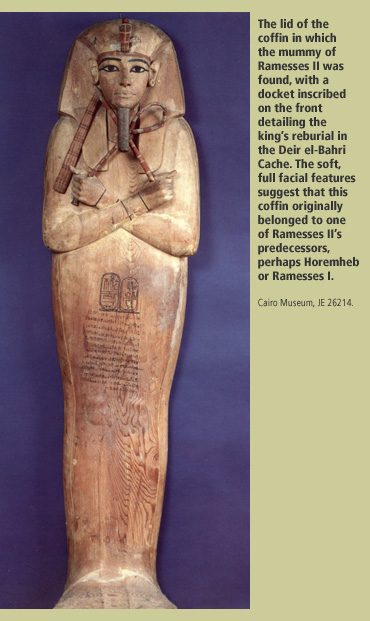
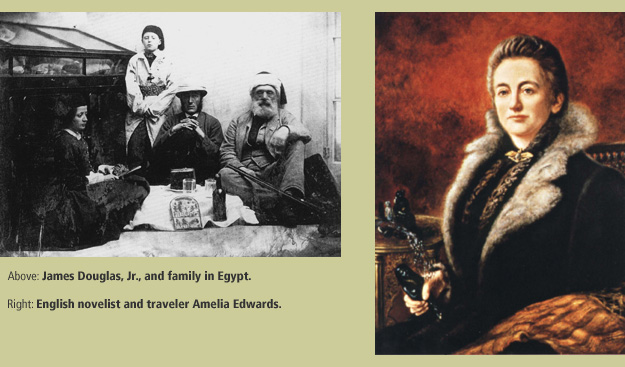
In 1827, a man named Thomas Barnett opened what would be known as the Niagara Falls Museum and Daredevil Hall of Fame, displaying curiosities and leading tourists behind the Falls. Even in the 19th century, tourism was big business in Niagara, with stiff competition between the various attractions. Barnett was always looking for new gimmicks, and decided to take advantage of public interest in Egypt fueled by the expeditions of Napoleon. So Barnett sent his son, Sidney, to Egypt three times between 1857 and 1861 to purchase mummies, coffins, and artifacts for his museum.Sidney Barnett's traveling companion, James Douglas, Jr., recounted that around 1860, he acquired an excellent mummy "in double cases, for Mr. Barnett, of Niagara Museum, for seven pounds." Douglas and Barnett both purchased artifacts, including mummies, from Mustapha Aga Ayat, a well-known middleman in the antiquities trade, and associate of the Abd el-Rassuls. It is highly likely that the mummy of Ramesses I was among these purchases, despite the uncertainty that shrouds the discovery of the Deir el-Bahri cache.
English author Amelia Edwards, traveling in Luxor in 1874, recounted "whispers about this time of a tomb that had been discovered on the western side, a wonderful tomb rich in all kinds of treasures." Upon the discovery of the cache in 1881, Edwards claimed that it had been located twenty years earlier, a time that would coincide with the Niagara purchases. Additional evidence is provided by the papyrus of Nodjmet, presented to the British Museum by King Edward VII in 1869. Nodjmet, a royal lady of the 21st Dynasty, was buried in the Deir el-Bahri cache, which is the most likely source for the papyrus. It is unknown when Edward acquired the papyrus, though it is certain that he had made a previous journey to Egypt-in 1863. Had he received the papyrus at that time, it would clearly support an earlier find date for the cache tomb.
In 1999, the Niagra Museum and Daredevil Hall of Fame closed its doors to the public, beginning a new chapter in the journey of this mummy. Seeking a home for their Egyptian antiquities, the Niagara Falls Museum contacted Dr. Peter Lacovara, an Egyptologist and Curator of Ancient Art at the Michael C. Carlos Museum. After examining the objects in Niagara, the Carlos Museum was definitely interested, though faced with a daunting fund-raising challenge. With less than two weeks to acquire the necessary funds, the local media and the citizens of Atlanta came to the rescue. The local papers provided front-page coverage of the unique situation and the people of the city offered donations ranging from handfuls of change to million-dollar pledges.
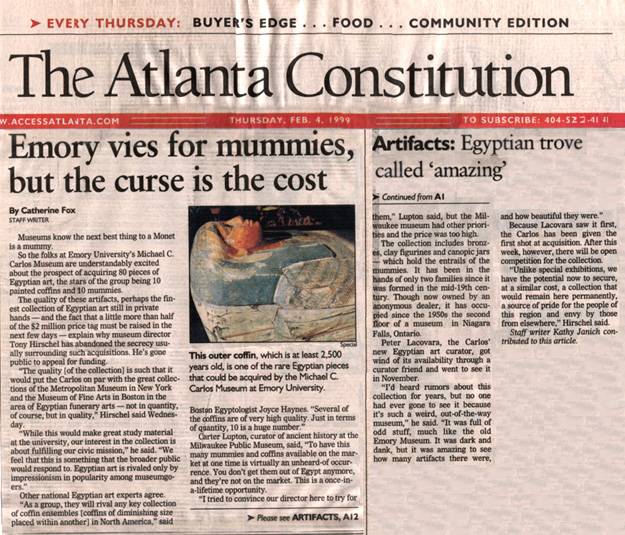
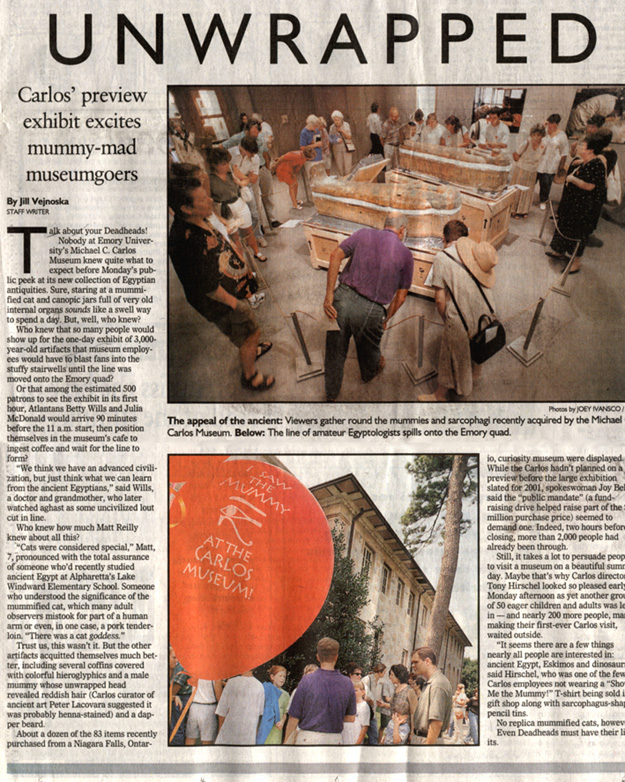
In July 1999, the mummy now identified as Ramesses I, and the rest of the collection reached their new home in Atlanta with great fanfare. Now known as the Charlotte Lichirie Collection of Ancient Egyptian Art, the beautiful painted coffins purchased by Douglas in the 19th century are now on permanent display in the Carlos Museum. Following a four-month exhibition, "Ramesses I: The Search for the Lost Pharaoh" in 2003, the Carlos Museum returned the mummy to the country of Egypt as a gesture of goodwill and international cultural cooperation.
If you intend to tour Luxor west bank and Eldeir ElBahari Temple with an egyptologist tour guide contact : info@egyptraveluxe.com




 Rekhmire (
 Neferuben (His Father)
 Bet (His Mother)
 Meryt (His Wife)


