Sunday, January 1, 2012


View of the east side of the settlement as seen towards west
Settlement
Temples
Chapels
Tombs
Rock shrine
Huts
Collections
Take a stroll along the eastern (lower) side of the settlement of Deir el-Medina, viewing each house from east towards west. The main
cemetery can be seen at the top of the photographs in the distance.
Scroll to the right to view all the houses.
This house used to belong to Neferhotep
Ipuy' house
This house used to belong to Ramose
Kaha's house is on the right
Plan of a typical Deir el-Medina house. Drawn by Lenka Peacock, after a drawing of Mary Winkes, in Pharaoh's workers.
Although the houses in the village varied in size they followed a fairly standard plan. The first room very often contained a rectangular
mud brick structure partially or fully enclosed except for an opening on the long side, which was approached by three steps. Bruyère found
remains of these structures in twenty eight of the sixty eight houses known to him at the site. The function of the bed-like constructions
is still being discussed by Egyptologists today. It has been suggested that they could have functioned as a birthing or nursing bed, or a
bed-altar to an ancestor cult. Fragments from several paintings from the exterior panels of some of these structures specifically involve
themes in female life: labour, childbirth and daily grooming. It is assumed that the villagers might have worshipped figures of deities or
supplicated a recently deceased relative within these bed-altars.
Recently it has been suggested (Brooker, 2009, p. 44-53) that the front rooms at Deir el-Medina were used as gardens. The suggestion
is supported by existence of several clay models of houses from other sites in Egypt displaying enclosed courtyards within the frontal
space. Archaeological evidence indicates that gardens were created on lower levels than the houses. The majority of floors in the front
rooms at Deir el-Medina's houses were at lower levels - some 40 to 50 cm lower than the street level. Textual evidence relating to the
front room and its purpose is limited, but Instructions and love poetry both suggest the importance of a private garden for an ancient
Egyptian.
The second room was the  main living room and it stood higher than the first one. The flat roof of the room was supported by one or two
wooden pillars that rested on stone bases. By archaeological evidence it is widely acknowledged that the second room had a sacred
significance. Offering stelae were found near shallow rectangular and arched wall niches, which occur in several houses in the first and
second rooms. Limestone offering tables were found in their vicinity. In the second rooms of most houses false door dedications were
discovered. All this evidence seems to indicate that the second room, among other multiple settings, was used to connect with and gain
protection of those outside the bounds of ordinary moral existence.
Some houses had a small chamber off the second room, which seems to have been used both as a general storeroom and as a place where
someone might sleep. Beyond this room there was a
kitchen and a staircase leading up to the roof, which was partially open to the air to
allow smoke to escape. Two cellars complete the dwell

This breathtakingly beautiful panorama was created by Warwick Barnard of Sydney, Australia, while he was walking across the Theban
      hills in January 2007. The magnificent panorama was rendered from six contiguous images and then processed into a reduced size
image. The original was over 25 MB.
Scroll to the right to view the whole picture.

Photography © Andy Peacock 2007

North-south view of the settlement
East-west view of the settlement and the Western tombs

Friday, December 30, 2011

Ancient Egypt: The civilization of God’s wrath


The pharoahs graves were dug up and looted. Their bones broken, their sarcophagus opened and their gold taken. Their tombs raided and their weapons sold off. Their graves moved or erased and or covered up. And this is the following of the nine gods. As I said in another chapter here, nine is of the occult and Egypt was one of the deepest of occult civilizations.
From their beliefs in the book of the dead and its magic spells to pass through the nine gates of the underworld to their building of the pyramids and their idols of half men, half animal gods. Their love was for gold and is of the god of riches and wealth. And all this and one man, one mild man God used to go in and go out and with him, take many out of bondage and slavery.
One man in a robe and staff to go up against the most advanced civilization of Egypt and against the pharoah! The place where the largest of structures of Earth have been built. And Moses walked it off like a good sport.

The egyptians worshipped cats, idols and were into black magic arts. The pharoah’s priests opposed Moses and tried to out do him with their magic arts, but Moses defeated that attempt with his single staff.
The pyramid has been a symbol of the occult and new age since any of us were born and when you see it, it is a warning to us that it is of something to think into the past about. When the one who was leader of this civlization defied God’s messanger and his warnings.
The pyramid is the symbol of idol worship and idolatry of self. When they say this is the true, original trinity and that the christian trinity is the follow up, false trinity…this is far from the truth. Do not believe this! The devil knew what was coming and does know his time is short and knows his fate. To counter God’s HOLY Trinity and to deceive many, he would create his own unholy trinity…in many forms. This doesn’t just come from the RA, ISIS, Horus trinity but there are others too. And just because it came BEFORE Christ…does NOT mean it is more true or more worthy than the trinity of the Father, Son and Holy Spirit.
The New age teachings are based on pyramidology, book of the dead, egyptology, black magic and channeling the unseen. These are the unseen forces that also the pharoah’s high priests were in touch with. And like Hitler who received information from such forces to create an anti-christ army, so too did the high priests of Pharoah to consult with the unseen to gain the knowledge needed for the building of the structures of Egypt. How else do we believe that Hitler knew so much more advanced technology for the domination of the air in his time, compared to the advanced technology of the pyramid structures during the pharoah’s time? His arm broken by God? The next anti-christ is said to be one armed and with one eye and with akward legs and twisted hair, stout in size and of the anti-messiah that many accept as the true messiah. How accurate those physical features will be…is only to be known when this comes.
Their god was the lord of the underworld, sun god RA and the mother goddess of earth, ISIS and the god of war, son of RA, the plant MARS is represented by this and is the aeon of Horus that is approaching for the end of days…days of the global order under the rule of the new pharaoh.
The protest by blacks in 07 that King Tut was black. Actually, he was Egyptian with dark skin that made him appear to look black but he was not African. There were simply similarities to the features but the African black is different of the Egyptian dark skin. Many of the blacks supporting this are going by only appearance. There are also asians who are chinese and korean and taiwan or Japan and many look alike but are different races. This is the same with King Tut.

Would you connect yourself with a civilization that received the WRATH of God? That insulted God’s messanger? That defied God’s words? That tested God’s will? That enslaved God’s people? That worshipped idols? That were involved in the underworld and the book of the dead vs the book of life? That were of astrology, fallen angels, nephilium connections and are today heavy within occult secret societies? Would you associate yourself with any symbol related to such? With any religion founded on such research as the Jehovah’s Witnesses and Mormans and Catholicism has basis in. Egyptian Oblisk center of the wheel at the vatican. Book of the Divine ages by Charles Russel of JWs. Egyptian plates read by Joseph Smith.
So, there you have it. This and there is a lot more to discover. However, today we have the novus ordo seclorum or New World Order under what on the back of US dollar? And what eye over the dollar? The all seeing eye of God or the eye of Horus? You be the judge. I simply show what is obvious.
I personally wondered for a long time why there is a pyramid on US $ money. And why anything related to Egyptian monuments or symbols are related to the Catholic church?

God took no time at all to take down the most powerful nation and civilization in the world with using the King of Babylon against the pharaoh and to scatter the people of Egypt and that HE DID. And it did not last against the God of Moses.
So…shall it come in our future, don’t be surprised of  the fallen angels and the new world order.
By Egyptraveluxe
info@egyptraveluxe.com 

Wednesday, December 21, 2011

Cleopatra, Antony and Caesar

Cleopatra, Antony and Caesar

The Greatest Love Story of all Time
Join the Tour 


Hollywood's protrayal of Cleopatra, Queen of the Nile, differs from the historical record, of course. Yet the real Cleopatra was even more fascinating than in the movies.


Born in Alexandria in 69 BC, she may not have been particularly beautiful. Her portrait on coins of the time shows her with a hooked nose and manly features, though her voice was said to be alluring, and she was obviously of high intelligence and ability. She was not actually of Egyptian blood, but of Macedonian, descended from one of Alexander the Great¹s generals who had come to Egypt in the 300s BC and established himself as King Ptolomy I.


She came to the throne as Cleopatra VII in 51 BC, at the age of 17 or 18. Exiled three years later in a palace coup, she regained her throne with Julius Caesar¹s help. He called for her to appear before him, but knowing that plotters would kill her on the way, she had herself rolled up in an oriental carpet and carried into the palace secretly. Servants unrolled the carpet before Caesar, and Cleopatra fell out at his feet.


The Roman general was captivated by the vivacious, independent-minded young queen with the beautiful voice and fiery eyes. Caesar restored Cleopatra to her throne and they embarked on a two-month-long cruise up the Nile. Their son Caesarion was born shortly thereafter.


Cleopatra visited Rome in 46 BC, was received in triumph, and moved into Caesar's villa even though Caesar was already married. Caesar's imperial ambitions and his indiscreet extramarital affair with Cleopatra turned powerful senators against him, and he was murdered on the steps of the Senate in March of 44 BC.


Cleopatra fled to Egypt, but was called to Tarsus (on present-day Turkey's southern coast) by Mark Antony, one of the new rulers of Rome, to account for her actions. She arrived, dressed as Venus, goddess of Love, aboard a sumptuous "barge" sailed by a crew of female servants dressed as sea nymphs. The ship had a gilded stern, silver-tipped oars, and purple sails. Antony was bewitched! He told her dirty jokes and she told better ones right back. Whatever he wanted to do, she would do with him, proving herself his equal. When she returned to Egypt, Antony went with her to spend the winter in Egypt's pleasant climate rather than rainy Rome.
Not long after Antony returned to Rome, Cleopatra gave birth to twins. In Rome Antony married his co-emperor Octavian's sister and started a family, but four years later he was back in Alexandria, unable to live without Cleopatra. He married her in 36 BC, and never went back to Rome. Rome had had enough! Octavian invaded Alexandria in 30 BC.
On the verge of battle, Antony's fleet went over to the Roman side, and soon also did his cavalry. Antony fled to Alexandria and, thinking Cleopatra dead, stabbed himself. On learning she was still alive he had himself carried to her, and died in her arms. Octavian captured the Egyptian queen and set guards on her to make sure she did not commit suicide. He wanted to parade her through Rome triumphantly in chains. But she arranged for a servant to smuggle in an asp (a poisonous snake) in a basket of figs. She ate the figs, and wrote Octavian a letter asking that she be buried with Antony.
Octavian, sensing what this meant, alerted her guards to an attempt at suicide, but it was too late. Queen Cleopatra VII was dead at the age of 39. She was buried with Antony, leaving behind her a love story the world will never forget.

History of Egypt - Cleopatra VII, the Last Pharaoh ... Octavian allowed Cleopatra to arrange Antony's funeral. She buried him with royal splendor. After the funeral she took to her bed, sick with grief


Alexandria ....... Mediterranean Fantasy.... and a Voyage Into History

Statue of CleopatraConquerors, emperors, ancient travelers and traders have all approached Alexandria from the sea . . . and so will you! Only Travel in Style makes it possible to experience the very essence of this ancient city as it should be experienced, as it was known by pharaohs, queens, and invaders from Marc Antony to Napoleon.
We'll set sail into the great harbor, still the destination and port of call for ships from the far corners of the world. Landward, we'll espy the great and throbbing maritime metropolis of Egypt. Our course will take us directly above statues that lie on the seabed, and stone slabs of the Lighthouse-one of the Seven Wonders of the Ancient World-toppled in an ancient earthquake. We'll approach the great stone fortress of Qait Bey, reputedly constructed with some of those very stones.
Then we'll set a course along the coast to the East Harbor, dropping anchor above the Royal City that was submerged by earthquakes and tidal waves in the fourth century A.D.
This underwater treasure house includes the palace of Cleopatra, the Timonium of Mark Antony, fallen columns and capitals, sphinxes, and statues and ceramics, much of it remarkably well preserved. Certified divers among our guests may book an optional excursion to explore this submarine Pompeii.
Along the way, we’ll view the spectacular Bibliotheca Alexandrina—the Library of Alexandria—as few are privileged to see it. Taking the stunning form of an inclined disk rising from the waters, it aptly captures the rebirth from the sea—in Pharaonic fashion—of the lost Alexandria Library of the ancient Greeks that held the works of the greatest scientists and philosophers of the ancient world. Like its namesake, the new Bibliotheca Alexandrina serves as a storehouse of knowledge and a beacon of culture and intellectual expression in this part of the world. Our maritime view is just a preview of our visit to the library itself.


Then we’ll set a course along the coast to the East Harbor, dropping anchor above the Royal City that was submerged by earthquakes and tidal waves in the fourth century A.D. This underwater treasure house includes the palace of Cleopatra, the Timonium of Mark Antony, fallen columns and capitals, sphinxes, and statues and ceramics, much of it remarkably well preserved. Certified divers among our guests may book an optional excursion to explore this submarine Pompeii.


Finally, we'll conclude an unforgettable voyage through history by setting a course to Abu Qir, where the French fleet under Napoleon was destroyed by Admiral Horatio Nelson.
The visit is a perfect counterpoint to a visit to the Qait Bey, where moving relics of the ill-fated fleet are on display.

Please note that this opportunity is limited to up to seven guests at a time. Two small cabins are available for changing and rest, as well as a bathroom, galley, dining salon, and sundeck. Our vessel is fully staffed by a crew of three, including captain. By prior arrangement, we can arrange for a sunset sailing, with cocktails and light music on your vessel's sound system, or a full day of sport fishing.
We can also make arrangements for you to meet and share dinner as guests of a local family.
This is an extraordinary opportunity to go beyond the limits of the casual visitor, to share your aspirations, outlook, customs, and experiences with people who have a lot more in common with you than you might ever expect. If you're interested, just let us know, and consider taking along something from your home town to leave with your hosts as a gesture of appreciation.
The recent discoveries join the New Library, opened just last year, among the top attractions in Alexandria. And the New Museum will shortly open in a historic palace that once housed the United States consulate. 

Join the Tour 

Saturday, December 3, 2011

How ancient Egyptians Were cutting the Obelisk from the Granite quarry?

Add caption


Today, quarrymen cut and carve granite using saws with diamond-edged blades and steel chisels.

But ancient Egyptian quarrymen and stonemasons didn't have these modern tools. How, then, did they quarry and cut such clean lines in their obelisks and other monumental statuary?
 
To find out how ancient Egyptians quarried huge pieces of granite for their obelisks, i traveled to an ancient quarry in Aswan, located 500 miles south of Cairo. This is where the ancient Egyptians found many of the huge granite stones they used for their monuments and statues.

One of the most famous stones left behind is the Unfinished Obelisk, more than twice the size of any known obelisk ever raised. Quarrymen apparently abandoned the obelisk when fractures appeared in its sides. However, the stone, still attached to bedrock, gives important clues to how the ancients quarried granite.


Archeologist Mark Lehner, a key member of nova expedition, crouches in a granite trench that abuts one side of the Unfinished Obelisk. Lehner holds a piece of dolerite similar to the kind that he and others believe Egyptian quarrymen used to pound out the trench around the edges of the obelisk. They then lifted the pulverized granite dust out of the trenches with baskets. Evidence also exists that workers pounded underneath the obelisk until the monument rested on a thin spine.

Lehner says that huge levers were probably used to snap the obelisk from its spine, freeing it so it could be carved more finely and transported.
Archeologists know that the ancient Egyptians had the skills to forge bronze and copper tools. Stonemason Roger Hopkins takes up a copper chisel, which works well when carving sandstone and limestone rock, to see if it might carve granite.

"We're losing a lot of metal and very little stone is falling off," observes Hopkins, which is hardly the desired result. Hopkins' simple experiment makes this much clear: The Egyptians needed better tools than soft bronze and copper chisels to carve granite.
As a young man, Denys Stocks was obsessed with the Egyptians. For the past 20 years, this ancient-tools specialist has been recreating tools the Egyptians might have used. He believes Egyptians were able to cut and carve granite by adding a dash of one of Egypt's most common materials: sand.

"We're going to put sand inside the groove and we're going to put the saw on top of the sand," Stocks says. "Then we're going to let the sand do the cutting."

It does. The weight of the copper saw rubs the sand crystals, which are as hard as granite, against the stone. A groove soon appears in the granite. It's clear that this technique works well and could have been used by the ancient Egyptians


Hopkins' experience working with stone leads him to believe that one more ingredient, even more basic than sand, will improve the efficiency of the granite cutting: water. Water, Hopkins argues, will wash away dust that acts as a buffer to the sand, slowing the progress.

Adding water, though, makes it harder to pull the copper saw back and forth. While Hopkins is convinced water improves the speed of work, Stocks' measurements show that the rate of cutting is the same whether water is used or not.
Besides cutting clean surfaces on their granite, the Egyptians also drilled cylindrical holes into their stones. A hole eight inches in diameter was found drilled in a granite block at the Temple of Karnak.

"Even with modern tools—stone chisels and diamond wheels—we would have a tough time doing such fine work in granite," says Hopkins.

Stocks was brought along to test his theories about how the cores were drilled. Inspired by a bow drill seen in an ancient Egyptian wall painting, Stocks designs a home-made bow drill. He wraps rope around a copper pipe that the Egyptians could have forged. Hopkins and Lehner then pull back and forth on the bow, which is weighted from above. The pipe spins in place, rubbing the sand, which etches a circle into the stone. With the assistance of the sand, the turning copper pipe succeeds in cutting a hole into the granite slab.
With the aid of a bow drill and sand, the pipe has cut a circular hole into the stone. But how can the drillers get the central core out?

Stocks wedges two chisels into the circular groove. The core breaks off at its base. Stocks reaches in and plucks it out, leaving a hole behind not unlike the ones once cut by the Egyptians

If you want to visit the Granite Quarry in Aswan where the unfinished Obelisk still laying down in the bed rock please contact us :info@egyptraveluxe.com
Half day tour to the Granite Quarry


Tutankhamun's Textiles Reconstructions of the clothing and textiles found in the tomb of Tutankhamun

Hundreds of garments and other textiles were found inside the tomb of Tutankhamun. Beside simple rolls of cloth and plain tunics, the tomb produced elaborate garments, sometimes decorated with fayence and gold. This collection of textiles is the only surviving royal wardrobe of the pharaonic period.
The Tutankhamun Textiles & Clothing Project
Howard Carter was aware of the importance of the textiles of Tutankhamun, but in the years after the discovery of the tomb in 1922 he never found time to make a detailed study. During ten years the tomb was gradually cleared and notes were made about every object found. In addition to numerous drawings and descriptions in diaries, more than 2500 record cards and over 1500 photographs were made by Carter and his team.
This material provided the basis of a detailed study started in 1993 by a team of the Egyptology department of the Leiden University led by Dr. G.M. Vogelsang-Eastwood, with the support of the Egyptian Museum in Cairo.


Sails, tunics and leopard skins types of textiles
The number of textiles in the tomb was impressive; over 740 garments, shrouds, covers of statues and textile objects like quivers and sails of boats models were found. Probably quite a few of textiles were stolen during the looting of the tomb, shortly after the burial. This explains the seemingly excessive number of loincloths: precious garments like royal tunics and sashes were taken away by the looters. It was not only the gold decoration of the garments which attracted the robbers. The linen of many tunics and sashes was extremely fine woven. With over fifty threads per centimeter, the decorative pattern of one of the surviving tunics
The textiles found in KV 62
137(+5) loincloths
13(+4) tunics
10(+1) sashes
3(+1) wings
1 royal jacket
1 cuirass/leather scale armor
25(+7) shawls
2 hip-wraps
1 nemes
20(+19) khats
2 aprons
4 kilts
6(+2) pair of gloves
2(+2) pair of socks
4(+1) guards/archer’s pads
4+ leopard skins
1 portable pavilion
1 large pall
6 shrouds
2 quivers
4 hassocks
1 cushion
1(+1) bags
1 horse housing
3 sails of boat models
106 wrappings and covers of statues and other objects
316 rolls, masses of decayed cloth, box linings, chariot linings (x)=number of uncertain identification
has been described as "painted".

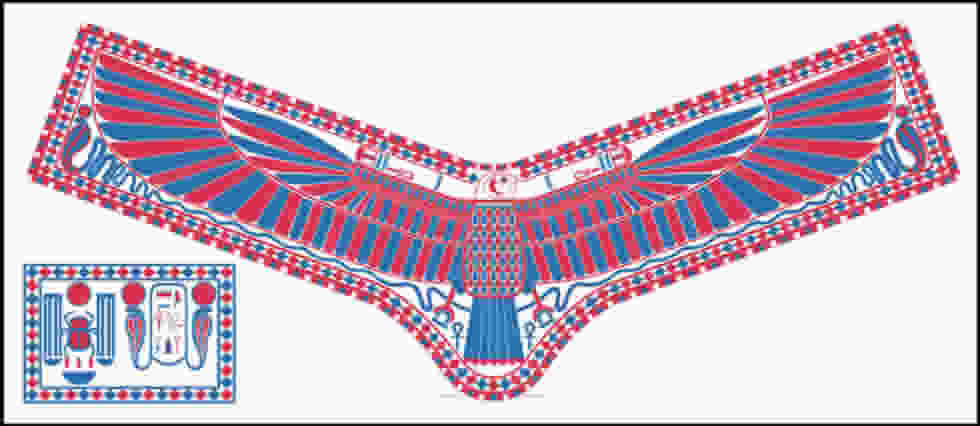
Wings
One of the most mysterious objects encountered during the research of the textiles, were short tubes of linen, with a pair of bird wings attached to it. Carter examined these textiles only shortly and described them in his notes as 'some kind of headgear'.
In many depictions of the pharaoh, protective wings are worn across the chest. In all these cases however, the body of the bird, mostly a falcon, can be seen slightly above the hips. It is unclear how these "falcons" are fastened to the body.
The wings found in the tomb of Tutankhamun were worn in pairs, the body of the birds resting on the shoulders, and with the wings across the chest and back. The tube section was in fact a short sleeve. Most likely the heads, and part of the bodies, of the birds were covered by a collar.
The conventions of the pharaonic art demand a complete as possible depiction of people, animals and objects, and especially important figures as kings, gods and protective birds like the falcon. This explains why these winged garments were shown lower on the body in the paintings and reliefs.


Wednesday, November 30, 2011

Tomb of Ankhtifi on a Tour to ElMoalla from Luxor

Some friends had requested to take them on a tour to ELMoalla ,I'v read about it before but the truth is I never visited before,so I started some searches and refreshment readings about the site,frankly there is not much about ,as there is not nuch left on the site ,here is some of what I'v got:
Gebelein is an archaeological site located about 32 kilometers south of Luxor (ancient Thebes) on the western bank of the Nile (The archaeological site is actually known as Naga el-Gherira). There are two hills at the site that give it its Arabic name of Gebelein, as well as its ancient Egyptian name of Inr-ti, meaning "two rocks". In Greek times, it was known as Aphroditopolis, and also Pathyris, from Old Egyptian Per-Hathor ("Domain of Hathor). The site is really not of much interest to casual tourists as there is little in the form of visual remains, though the hills provide a good view of the Nile Valley. It may be of some interest, however, more because of the artifacts that originated here that are now spread around in various museums.This site was known to the authors of the Description del l'Egypte, but it was not explored until 1884, after clandestine excavation indicated its importance. Investigations were then carried out by E. Grebaut and G. Daressy in 1891, J. Morgan and G. Foucart in 1893, G. W. Fraser and M. W. Blackden for the Egyptian Exploration Fund in 1893 and H. de Morgan, L. Lortet and C. Gaillard between 1908 and 1909.The objects found by the first phase of exploration are now kept in Cairo, Berlin and Lyon. The Guimet Museum in Lyon holds two extremely important prehistoric statuettes. The Egyptian Museum of Turin, then directed by Ernesto Schiaparelli, began its excavations in 1910, continuing in 1911, 1914 and 1920. Schiaparelli's successor, Giulio Farina, worked there in 1930, 1935 and 1937. The Turin Museum renewed explorations and excavation during 1990 in order to draw an archaeological map of the site. However, this turned out to be more of a rescue-archaeology mission after the team was informed by the local antiquities inspector that the local farmers were planning on extending their sugar cane fields into some parts of the archaeological site.

The region was obviously dedicated to the cult of Hathor, but was also a major cult region for Sobek, the crocodile god as weThe eastern hill at Gebelein is dominated by the remains of a temple of Hathor, the decoration of which dates primarily from the 11th to the 15th Dynasties. However, this temple was certainly established by the end of the Early Dynastic Period and was still in existence during the Roman Period. It was later destroyed for its limestone.
The temple of Hathor stood within a fortified wall of mud bricks (dating to the Late Period), on which the cartouche of the high priest Menkheperre, son of Pinudjem, is carved. Objects found include a royal stela from the 2nd or 3rd Dynasty, many fragments of wall reliefs from the reign of Nebhepetre Montuhotep I (11th Dynasty) and from the 13th and 15th Dynasties, a foundation deposit from the time of Tuthmosis III, stelae and some stela fragments from the New Kingdom and some Ptolemaic reliefs. Hence, the site was occupied over a long period of Egyptian history.
From the area of the town, located below the eastern hill, have come several collections. Together with papyri, there are probably more than four hundred Demotic and Greek ostraca, discovered by Shiaparelli, which reflect the life of the mercenary garrison quartered there from 150 to 88 BC. Other Greek and Coptic (Christian) texts on sheets of leather, dating from the late 5th and early 6th centuries AD, constitute evidence of the presence of the Blemmyes at Gebelein or on the island facing it.The necropolis extends along the eastern slopes of the western hill and onto the northern plain. It yielded evidence from the Predynastic Period to the end of the Middle Kingdom. Among the most important discoveries were a Naqada II painted sheet, showing boats and funerary dancers, some Predynastic tombs with black-topped pottery and a series of administrative papyri from the end of the 4th Dynasty, which show great similarity to slightly later papyri discovered at the pyramid of Neferirkare at Abusir. Notable features of the necropolis included an intact tomb from the 5th Dynasty containing three burials with rich furniture, a tomb with equipment from the end of the 6th Dynasty, a 10th Dynasty tomb (now reconstructed at the Turin Museum) with unique stylistic characteristics belonging to Ini, nomarch and high priest of the temple of Sobek, Lord of Sumenu. The porticoed tomb of another Ini, a general and treasurer of the 11th Dynasty, was decorated with a series of paintings of ceremonial scenes (in the chapel) and images of daily life (on the pillars and walls of the portico). These paintings are of extraordinary interest because they combined Egypt's classical style with novel and lively elements, typical of provincial culture. The end of the 12th Dynasty is attested by some inscriptions of Coffin Texts and by the remains of the rich equipment of Iger that was devastated by thieves and termites.
Stelae of Nubian mercenaries of the First and Second Intermediate Periods display a rough, vigorous style. These are now in various collections, including the Turin Museum, along with objects from the C-Group and Pan-Grave cultures that displayed both provincial elements and some Nubian influence.
El Moalla: We started the Tour at 9am .and we drove for nearly 40 min. toward ElMoalla ,it is a small village on the east side of the river Nile ,after we crossed the railway road ,we were right at the feet of the mountain where The Tombs of The dignitaries (Noble's) of the region were cut into the mountain rock, the biggest and the best recognized is the tomb of Ankhtifi ,who was the mayor of the region ,showed a degree of independence from the central power weekend at the end of the old kingdom, and from here the importance of the region, as the tombes consider a rare reference recording that particular period of Egypt's History nearly around 2000BC.
the tomb of Ankhtifi ,will impress you as a visitor ,the tombe size is huge comparing to similar tombs of that period ,the columns are unique in  architect design  reflect the simplicity and the primary in columns architect further south way from the great pyramids builders in Giza ,The intact scenes and colours will definitely impress you .
The Biography of Ankhtifi : Ankhtifi was the nomarch of Hierakonpolis and a supporter of the Herakleopolitan based 10th dynasty which was locked in conflict with the Theban based 11th Dynasty kingdom for control of Egypt. Hence, Ankhtifi was a rival to the Theban rulers Mentuhotep I and Intef I. He lived during the early First Intermediate Period when the Egyptian Old Kingdom state had collapsed and chaos, hunger and famine stalked the land. Ankhtifi, as nomarch or governor of the third nome of Upper Egypt, built and extensively decorated his tomb at El-Mo'alla and inscribed the tomb’s walls with his autobiography which details his initiatives in re-establishing order in the land, his resistance against Thebes and the appalling suffering of the people of Egypt during his lifetime. It is one of the most significant inscriptions to come from the early First Intermediate Period after the collapse of the Old Kingdom. Ankhtifi states in his tomb autobiography:

"The Prince, Count, Royal Seal-bearer, Sole Companion, Lector-priest, General, Chief of scouts, Chief of foreign regions, Great Chief of the nomes of Edfu and Hierakonpolis, Ankhtifi, says: Horus brought me to the nome of Edfu for life, prosperity, health, to re-establish it, and I did (it)...I found the House of Khuy inundated like a marsh, abandoned by him who belonged to it, in the grip of the rebel, under the control of a wretch. I made a man embrace the slayer of his father, the slayer of his brother, so as to re-establish the nome of Edfu (...) I was as concerned for the lowest of men as for the highest. I was the man who found the solution when it was lacking in the country thanks to poor decisions, and my speech was clever and my bravery won the day when it was necessary to join the three provinces together. I am an honest man who has no equal, a man who can talk freely when others are obliged to be silent.
"The general of Armant said to me: 'Come, oh honest man. Sail with the current down to the fortress of Armant!' I then went down to the country to the west of Armant and I found that the forces of Thebes and Koptos had attacked the fortress of Armant (...) I reached the west bank of the Theban province (...) Then my courageous crack troops, yes my bold crack troops, ventured to the west and the east of the Theban nome, looking for an open battle. But no one dared to come out from Thebes because they were afraid of my troops."
(Inscriptions 1-3, 6-7, 10 and 12; Vandier, 1950, 161-242)[1]
"I gave bread to the hungry and clothing to the naked; I anointed those who had no cosmetic oil; I gave sandals to the barefooted; I gave a wife to him who had no wife. I took care of the towns of Hefat [i.e. el-Moalla] and Hor-mer in every [situation of crisis, when] the sky was clouded and the earth [was parched (?) and when everybody died] of hunger on this sandbank of Apophis.The south came with its people and the north with its children; they brought finest oil in exchange for the barley which was given to them.
"The whole of Upper Egypt died of hunger and each individual had reached such a state of hunger that he ate his own children. But I refused to see anyone die of hunger and gave to the north grain of Upper Egypt. And I do not think that anything like this has been done by the provincial governors who came before me....I brought life to the provinces of Hierakonpolis and Edfu, Elephantine and Ombos!" (Inscriptions 1-3, 6-7, 10 and 12; Vandier, 1950, 161-242)[3]
Ankhtifi's autobiography highlights the political fragmentation of Egypt during his career as nomarch of Hierakonpolis because he describes himself "first of all as the chief of his province" or of his three nomes rather than the governor of a region of Upper Egypt as Pepi I's confidant Weni did during the 6th dynasty. His autobiography also shows that he only became nomarch of Edfu after seizing it from Khuy, who was an ally of Thebes.While Thebes later defeated his forces and won control over Edfu, Hierakonpolis and Elephantine under the Theban kings Intef I and Intef II, the completion of his tomb suggests that Ankhtifi was not personally defeated in battle himself.
Ankhtify's autobiography demonstrates that the fear of an economic crisis was endemic in the early First Intermediate Period when local town magnates publicly boasted of their ability to feed their own towns while the rest of Egypt was starving. Evidence that famine did afflict the land comes from a worker of a Koptos 'overseer of priests' who modestly relates that he "stood in the doorway of his excellency the overseer of priests Djefy handing out grain to (the inhabitants of) this entire town to support it in the painful years of famine." It was previously uncertain if a series of Low Annual Nile floods caused the mass famine rather than the outbreak of chaos following the collapse of the Old Kingdom since some archaeological observations from Elephantine appear to indicate that Egypt was actually experiencing slightly above average flood levels during the First Intermediate Period. However, more recent archaeological evidence since 2000 now suggests that Ankhtifi's comments concerning the severity of the famine--at least during the early First Intermediate Period--are indeed based on fact and not propaganda.

An Egyptian scientist, professor Fekri Hassan from University College London has discovered clear evidence that a sudden global climate change caused the complete drying up of Lake Faiyum--a major body of water which was fed by the Nile and is 65 metres deep--between 2200 to 2150 BC, around the start of the Old Kingdom's collapse. The evaporation of the lake's water, which occurred over a period of several years, hints at the severity of the drought which impacted Egypt during this time ,the fascinating details of  the scenes are highly remarked ,The bareback ass scene and the asses are still intact scenes ,represent their primary transportation ,another perfect intact scene of a  Barbecue of fish and beef ,the cartouch of Nb Ka Ra still preserved ,the turquoise colored is well recognized as the green color as well ,after we finished this tomb of Ankhtifi we proceeded to Tomb of Sobekhotep which was not in a good condition as the whole area was vandalized  and robbed  ,the tombe consisted of 3 shafts and traces of decoration and colours ,still hardly to be recognized ,outside is a storage room located to store what has been saved from the area .
we proceeded back to Luxor ending our special tour.
Photo Gallery :


The natural pyramid shape can be clearly seen in this picture and there are many tombs here but only two that are open to the public and only one - that of Ankhtifi - that makes the journey worthwhile to anyone less than an expert.

The entrance to Ankhtifi's tomb is the dark area at the centre of the picture and thankfully once through the doorway you are directly in the tomb.


The light comes from the entrance which is on the right of this picture directly in line to the cordoned off shaft to the burial chamber.On the pillar on the far side of the shaft is carved Ankhtifi which is more clearly seen in the next picture.


They show, amongst others, this fishing scene - of which we can only show you part of in this picture.


This very detailed scene shows many types of fish.The use of colours is quite unusual to what we are used to seeing in the Theban tombs.


 Just one of many scenes painted on the columns. You can see more in the next picture.
It is the line of donkeys painted along the lower section of the back wall of Ankhtifi's tomb that really fascinated us as we have never seen this in any other tomb. Donkeys do appear occasionally as on the walls of Queen Hatshepsut temple but then there is just the odd one or two not an entire row like this.


A barbecue scene ,and the man who is on barbecue is tasting the barbecue.


A bugs bunny to be barbecued


On the back wall behind the shaft we see Ankhtifi and his wife seated but little remains of the detail on the rest of this section of the wall.


 Tod Temple

 what are these? They look like Egyptian cartoon characters.


 If you want to go there contact me and Ahmed ,we always recommend this tour for Luxor 2nd time visitor who is enthusiast to see new staff every time.
info@egyptraveluxe.com

Nahla Elkady
Egyptologist tour guide

The Mastaba of Ti at Saqqara

  The wall measures 1.55m wide by 4.50m in height, of which the upper 2.75m is decorated. It contains scenes with seventy-four characters di...