Here, Kagemni, of which only his feet remain, was seated in front of a troop of fourteen dancers, dancer-acrobats and women clapping their hands and executing a stance which is difficult to imagine. The bodies are bent backwards, almost horizontally, while both of their arms and a leg are nearly vertical. The way it is represented, they would certainly fall over
we r Interested in introducing Egypt in depth to the enthusiast tourists who love Exploring and learning about ancient and modern Egypt. my private tours are diverse and cover many spots of Egypt ! , I am able to recognize my guests interest , and give them exactly what they are expecting and to take the appropriate attitude to their personality (history, arts, sites, nature, astronomy, politics, etc). I will tailor the tour according to your budget, needs and interests.
Tuesday, February 7, 2017
The tomb of Kagemni
Kagemni is found represented at heroic height on this wall, in a pastoral scene of breeding and taking care of the herds.


a herd crosses a ford. A peasant sitting in boat has the whole herd crossing while attracting the mother with a calf, which he holds by a foreleg and by a rope. The calf tries to swim while turning its head toward its mother and while mooing. This attracts the mother and the whole herd.At the rear of the herd a drover raises his stick to drive forward the last reluctant oxen. Behind him a man makes to cross the ford with a calf, undoubtedly very young, which he carries on his back ... it does not appear to be very happy (
Crossing the ford is dangerous, not just for the beasts, but also for the men. Indeed, besides the usual fauna of fishes, there are crocodiles and hippos to look out for.

a herd crosses a ford. A peasant sitting in boat has the whole herd crossing while attracting the mother with a calf, which he holds by a foreleg and by a rope. The calf tries to swim while turning its head toward its mother and while mooing. This attracts the mother and the whole herd.At the rear of the herd a drover raises his stick to drive forward the last reluctant oxen. Behind him a man makes to cross the ford with a calf, undoubtedly very young, which he carries on his back ... it does not appear to be very happy (

On the second register servants take care of the milking of cows, which have been tethered to stop the animals from moving (and to help keep away the calves which have not yet been weaned, which obviously seek to suckle their mother
To the right, two men are seated face-to-face on some sort of thick vegatable matting. They manufacture faggots from stems of papyrus, even though it is difficult to understand the nature of the instruments which they hold in their hands; nevertheless the action is indisputable since the hieroglyphic wording of the scene is "qeni", which means faggot or bundle

Another servant, seated in a strange kind of basket, weans a young pig to which he seems to regurgitate milk into its mouth. Note (as an aside) the pig, which is known from excavations to have been abundantly preserved, is hardly ever represented in tombs, probably considered as an impure animal. Besides, it will later become an animal connected to the god Seth

the tomb of Kagemni

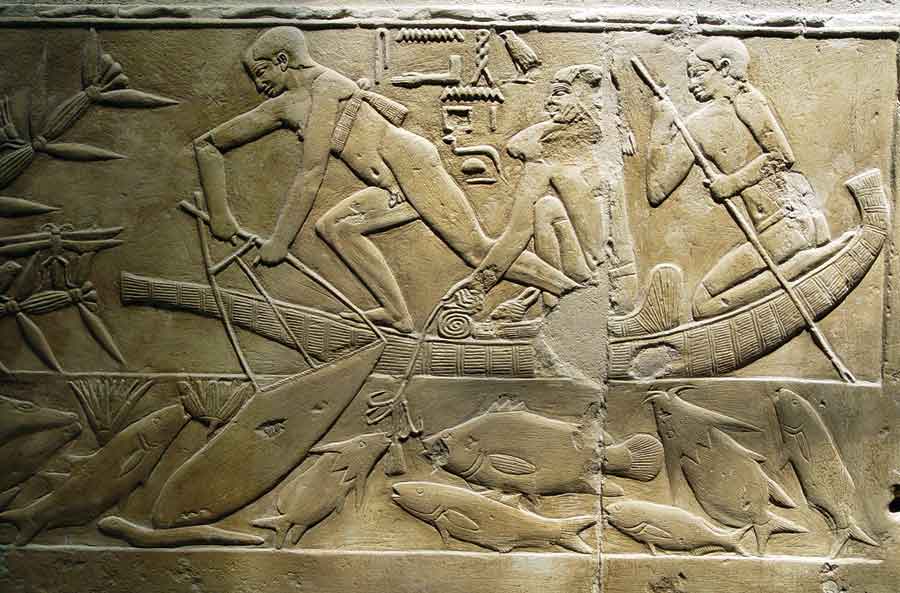
Kagemni, of whom only his feet remain, appears standing upright on a papyrus boat, itself slipping in the dense papyrus lined marshes whose plants are represented by upright stems. He is evidently fishing in the marshes. In front of him appears a small boat, also of papyrus, which transports three men dressed in a narrow belt and a flap of material allowing freedom of movement, which normally acts as a loincloth to cover their sex and save embarressment


The one of the rear, squatting on his heels, directs the frail craft. The one of the middle throws a line with several fishhooks (several different species of fish can be seen approaching). At the front, a character obviously makes a considerable effort to raise a heavy hooped net of fish. His minimal loincloth is raised around his shoulders. Among the represented species are: carp, mulet, mormyridae (elephant fish), catfish, synodontes, tilapia .... These Nile perch (which are nowadays still found at our fishmongers) are also perfectly identifiable; there are also eels.
Notice how far the artist/craftsman has taken the detail: on the branches immediately

in front of the boat, can be seen a frog, a grasshopper dragonfly
Other representations of the same type are present Some dangerous animals can also be seen in this hostile environment, where the order required by Ma'at doesn't reign; so there is a battle between crocodiles and crocodiles hunting fish, one among them having made a large catch .
The composition shows well the panic of the potential victims, who flee in all directions. Because there is an obvious immediate reading for this scene, it is necessary to imagine secondary symbolic one. The marsh is the border zone between the unorganised environment (or Isfet) and the semi-organised one of Egyptian men, in accordance with the will of the gods (this is the zone of Ma'at). While hunting the wild animals, these are also the demons which are hunted and which are thus prevented from penetrating into the most intimate parts of the tomb.
BIOGRAPHY OF KAGEMNI
This spreads across part of the facade, on either side of the entry doorway. The text itself is thus divided into two symmetrical and complementary parts, which also show a complex nature. In the narration it is impossible to find, as anywhere else, a distinction between ideal good deeds, practical offices performed for the pharaohs, and pealing to the visitors. The three kinds are merged in a typically narrative style which takes into account the chronological stages of life. The spirit of the speech seems to exceed the traditional concept of a just and pious man, to describe his recent office of authority: the nomarch.
Source: PM III, p.521.
Publication: Urk. I 194-196; MIO 1 (1953), 210-226.
Comments: Junker, Pyramidenzeit, p.54; Edel, Untersuchungen, § 53, p.68-71 ;
Janssen, Autobiografie, I Af 2; IIS 1, V 2, Bl 29, Bz 37, Dv 1, Hc 12-13.
Translation :
§ 113 'The State Vizier, Kagemni, says: "I was the favourite of Isesi. I filled the task of civil servant of the state, in the time of Unas. His Majesty rewarded me very generously, [and when I came to the Residence,] His Majesty rewarded me for it very generously.
The majesty of Teti, who lives eternally, reached the Residence... [His Majesty] learned their name in the Palace, then His Majesty ordered all things which His Majesty wanted, [which one made happen in the courthouse of the Six. As for] all things which His Majesty had justly ordered to be done in the courthouse of the Six, [it was justly done by my action.] It was with a deep desire that His Majesty wanted [that I should render justice] in all things which he ordered.".
§ 114 'The Vizier of the State, Kagemni, says: "[The majesty of Teti, my Lord, he who lives eternally, named me as the head of] all offices, on service at any hour (at) the Residence. His Majesty had confidence with regarding all things which His Majesty had ordered to be done, [because I was capable, because I was appreciated by His Majesty]".
"[Oh living... accomplish] justice for the king, because it is justice which the God likes. Known as Ma'at (to the king, [because it is truth which the king likes. Oh living...] you won't be able to throw slanders against me, because the sovereign knows my character and my conduct [and His Majesty has confidence in me, pleased that in his civil servant who is in this country, because I am] someone who speaks the truth and repeats the good in what the king likes. I desire that good is in me near the king and the great god, [and I desire that my condition of Imakhu is close to men and close to the great god. I judged] the parts so that they were satisfied, I fed the poor person, [I removed the pain of the grief-stricken.]"
Texts of bewitchment follow, in a rather fragmentary state.
Based on Alessandro Roccati: "La littérature historique sous l'Ancien Empire Égyptien", Ed du Cerf, 1982, p 139-141.

the Tomb of kagemni at saqqara
As with all high officials, he was attributed with dozens of titles (53 in total), some of which were purely honorific, but some were of functions which he actually performed. He would have held many of these before taking on the high office of vizier.
| Hereditary Noble | |
| Count | |
| Chief Justice (literally: "He of the curtain" and of high status) | |
| Vizier | |
| Chief Lector Priest | |
| Gracious of Arm (The meaning of this title is not clear) | |
| Sole Companion | |
| Mortuary-priest of Anubis | |
| Stolist-priest of Min | |
| Scribe of the God's Book | |
| Director of every Divine Office | |
| Master of the Secrets of the Sacred Language | |
| (Sole) Confidant of the King out of his (the king's) Two Banks | |
| Treasurer of the King of Lower Egypt | |
| Sem-priest | |
| Director of every Kilt (possibly meaning "Director of all Officials") | |
| Overseer of the two Treasuries | |
var. | Overseer of the two Granaries |
| Overseer of the Six Great Mansions | |
| Mouth of every Butite | |
| Overseer of the Two Wabet-chambers | |
| Overseer of the Two Houses of Gold | |
| He who is in the Chamber (i.e councillor) of Nekhen | |
| Herdsman (i.e. ruler) of Nekhen | |
| Chief of Nekheb (El-Kab) | |
| Overseer of the Scribes of the Royal Documents | |
| Master of the Secrets of that which (only) the One sees | |
| He who has Might with the Gods | |
| Domain-administrator of (the vineyard) "Star-of-Horus-President-of-Heaven" | |
| Director of the Mansions of the Red Crown | |
| Director of the Mansions of the White and Red Crowns | |
| Inspector of the Pyramid "The-Places-of-Teti-are-Enduring" | |
| Inspector of Priests of the Pyramid "The-Places-of-Teti-Son-of-Re-are-Enduring" | |
var. | Overseer of the Town of the Pyramid "The-Places-of-Teti-are-Enduring" |
| He who is in the Chamber (i.e councillor) | |
| Master of the Secrets of Secret Missions | |
| Overseer of all Works of the King | |
| Overseer of all (Judicial) Hearings | |
var. | Overseer of the Two Chambers of the King's Wardrobe |
| Overseer of Upper Egypt | |
| Overseer of Upper and Lower Egypt | |
| Overseer of the Entire Land, Upper and Lower | |
| Overseer of the Two Royal Domains | |
| Master of Secrets | |
| High Priest of Heliopolis | |
| Overseer of all Commands | |
var. | Overseer of all Commands of the King |
| Attached to "Fair-is-the-Face" (a name of the crown) | |
| Overseer of the Two Chambers of the Seal-bearers | |
| Overseer of Commissions in the Entire Lands | |
| Overseer of the Fowling-marsh | |
| Overseer of the King's Fowling-marsh | |
| Judge and Nome-Administrator |
Subscribe to:
Posts (Atom)
The Mastaba of Ti at Saqqara
The wall measures 1.55m wide by 4.50m in height, of which the upper 2.75m is decorated. It contains scenes with seventy-four characters di...
-
Hesire was a high official who lived during the reign of Netjerikhet (Dosjer) 2686 BC to 2613 BC . His tutelary informs us of the...
-
one of the rare Egyptian tombs which dates from the reign of Amenhotep I. From a decorative view point, one feels here the inf...
-
The ANM is the latest museum to join the many others present in this coastal city. It is housed in a beautiful 3-storey Italian-style bu...