Wednesday, January 4, 2012

Learn about Ancient Egypt Food and drink from tombs at Deir el-Medina

Food was received by the villagers in Deir el-Medina in a form of regular rations as a salary (mainly grain, with water and firewood, also beer, oils, ointments and garments). Food was also paid as a transferable pension - “old workmen” and their widows also receive sacks of grain.
Workers also received irregular extras from the temples (part of the unused offerings after the Gods ‘fed themselves on the essence’ – mainly bread and cakes) or rewards from the Pharaoh (on the occasion of his wedding, birthday or religious festivals) – these would consist of some more luxurious items such as vegetables, fruit, beans, meat, oils…)
Sources for our knowledge:

• Core texts. Mainly delivery notes and receipts on ostraca and papyri.

Artefacts found in the archaeological excavations. This includes real foodstuffs or herbs as well as their representations on offering tables. Mainly from the tombs like that of Kha or Tutankhamun, but also from the village site and the dump – this is where archaeobotany and zooarchaeology come to play.
Tomb paintings and decorations, which show resources available to the Ancient Egyptians

Daily Food: Seven Key Texts

1. Ostracon Berlin 11238
The Mayor of West Thebes Ramose informs the two chief workmen and their crews that he has received a message from the Vizier Paser, saying:
Please let the wages be delivered to the crew
of the necropolis, consisting of:
vegetables, fish, firewood, beer in small vessels,
small cattle and milk.
Let nothing of it be postponed, so that I would
be in arrears with their wages.
Be at it and pay heed!


2. Ostracon Gardiner 59 (in Oxford)
Written from the workmen to a Vizier:
To let our Lord
(the Vizier) know:
As regards the vegetables, oil, fish, our garments,
our ointment and our grain rations,
our Lord himself
(Pharaoh) has provided
us with these means of subsistence.

3. Ostracon DeM 60 (in the French Institute in Cairo)
What Neferhotep said, in the 3rd  winter month, day 22
(Note: this is the 19th Dynasty):
Water deficit for the Left side:
Prehotep
1 ½ sack
Nebamente
1 ½ sack
Khabekhent
1 sack
The watchman
¼ sack
The servant woman Saroy
½ sack


Total of the Left side
4 ¾ sack

4. Ostracon Stockholm MM 14126
(water delivery, probably for one day)
[House of] Nebamente
¼ sack
House of Amenakhte, son of Dgdy
½ sack
House of Mose
½ sack
House of Pashedu, son of Harmose
½ sack
House of Karo
½ sack
[House of Pashedu], son of Hehnakht
¼ sack
[House of] …
¼ sack
[House of] … son of Sibe
½ sack
                                       etc.


5. Ostracon Cairo 25608
Giving rations for the second month of summer /1:
The chief workman
2 sacks (barley)
5 ½ sacks (emmer)

The scribe
2
5 ½

17 men, each
1 ½
4
that is 25 ½ + 68
2 young men, each
½
1 ½
that is 1 + 3
The guardian
1 ½
3 ¼

The slave women /2
1 ½
1 ¼

The doorkeeper
½
1

The doctor /3
¼
1


Total /4
32 ½
84 ¾

Notes:
1/ Deliveries for the Left side only
2/ This is the total for all slave women
3/ The doctor was also a regular member of the crew, so this is likely an extra pay he received for healing
4/ In reality, the total is: 34 ¼ and 88 ½ . To be considered: Was this scribe bad at maths? Or did he cheat on purpose and keep the rest of the grain for himself? (There are other instances where the total written is lower than the real sum.)
6. Ostracon Cairo 25504
Year 8 of Merenptah. On day 20 of the second month of the inundation season someone came to the workmen to reward the crew.
He gave them as reward:
9000 loaves of bread
20 vessels of oil
9000 fish
20 sacks of salt and 400 blocks of it
Also beer and beans (3 sacks) and more that is lost.
Finally, they received 10 pieces of cattle, which were slaughtered.
7. Ostracon DeM 46
Mentions the delivery of the following articles on a particular day:
11 oxen
9 more received a few days later, which are said to be shared out
The next month there came:
5 head of cattle: 4 for the crew and 1 for the three leaders, the chief workmen and the scribe
That day also:
280 fish received.

What food?

Grain

Ordinary workmen were pain their monthly wages in grain: usually 1 ½ sack of barley and 4 sacks of emmer (Egyptian sort of wheat)
Grain was used for making beer and baking bread or cakes, and was ground mostly by the slave women with a grinding stone (bits of the stone frequently mixed with the flour, which is one of the reasons for bad teeth).
If you want to see more examples of the grain found in Egypt, just type barley or emmer in the “Search the descriptions“ field in the Petrie’s Online Catalogue.

Bread

Baked from emmer and barley, with various ingredients (dates and honey for sweet cake-like bread, or herbs and garlic for savoury).
There are many different ancient Egyptian names for bread and many depictions of bread loafs of different shapes (round, oblong, triangular, with one or two holes…)
 BM 40942 from Compass


Bread and cakes were often delivered as a reward for the villagers from the Temples.

Vegetables

Garlic: We saw an extract from the documentary film “The Gift of the Gods -- The Vital History and Multiple Uses of Garlic” (70 minutes, David Douglas Productions, Cremorne, NSW, Australia, 1991) where Jack Janssen was talking about the use of garlic in Ancient Egypt and certain artefacts from the Petrie museum like the garlic models.
UC 6054
Garlic models Jack talked about
 
Onion (often consumed with bread and fish), lettuce (juice ‘aphrodisiac’) leek, beans & lentils, cucumbers, celeriac (top herb for flavouring)

Fruit

The Egyptians ate and still eat mainly dates and figs, which are an excellent source of energy and are used in many desserts. Apart from regular date palm, they consumed also a fruit from Sycamore trees, which gave smaller and yellower dates.
BM 5396 from Compass
Basket with figs and dates
The best example I found is this basket with dates and figs from the British Museum, but there is also a nice pottery dish with dates, from West Bank Thebes, possibly New Kingdom, now in the Liverpool Museum (M11908-909).
The Ancient Egyptians also used fruit from another palm tree - it was a dôm-palm (Arabic name for Hyphaene thebaica), which gives fruit a bit like small pomegranates with a small nut inside, which contains a sweet oil (for more see Maniche Herbal pp.114-115)
Dôm-palm can be seen on a wall painting from Irinufer’s Tomb TT 290 (Ramesside Deir el-Medina) – for the picture and more details about the tomb, see Waseda Theban Database.
BM 5395 from Compass
Basket with dôm-palm fruit
Dom palm fruit example shown here is from the BM collection. There are also some dôm-palm nuts in the Liverpool Museum (M11123).
Other fruit known by the Ancient Egyptians and perhaps eaten by the villagers in Deir el-Medina, at least on some special occasions: pomegranates (frequent on the tomb walls, but probably a luxury), grapes, rare apples and olives (Akhenaten’s olive branch)

Meat

Ordinary villagers had meat rarely, as a treat, not daily, unlike the courtiers and nobles (check British Museum Compass for Box of food of Henutmehyt EA 51812). Meat figures frequently on the tomb walls, however this is usually a depiction of an ideal life in the Other world.
They probably ate mostly fish – abundant from the river – and wild fowl (not chicken though, which was introduced much later, in Roman times).
Most common fish: mullet and bulti fish. Each side getting about 250 kg of fish every month. Fish were salted to preserve them, then baked or roasted.
from Compass
Garden pool from Nebamun's collection with various kind of fish
 
Depictions of fish on the walls of temples or tombs are frequent, like in Nebamun's collection (for more see British Museum Compass) or at Deir el-Bahri.  

Other kinds of meat consumed: geese and ducks (plucked, cut, flattened and roasted), pigeons, quail…); cattle (small - sheep, goats; large - cows, oxen) and pigs (many pig bones found in excavation sites). They consumed also eggs and diary (milk, clear butter and some cheese).
Seasonings
Salt, juniper berries, cumin, cinnamon, celeriac herb
For sweetening – mostly honey, date and fig pulp or syrups

Beverages

For various drinks check out this Internet source (with care, as always).

Water

Water for the villagers in Deir el-Medina was (supposed to be) delivered daily by the water carriers (see above, texts 3 and 4). It was measured in sacks – Khar - like grain, and used for drinking, cooking and personal hygiene (not for laundry, which was washed by the ‘laundry men’ in the river).
Consumption: 1 ¼ to 1 ½ sacks a day per household (approximately 6 people), that would be 16-19 litres a day per person.
Water for drinking most likely from the river (mummies contain parasites known from the contaminated Nile water). There were several attempts to dig a well in Deir el-Medina, all unsuccessful and abandoned.

Beer

Thick soup-like consistency, very nutritious. Made from sour-bread partly baked, crushed and mixed with water, after the fermentation sieved.
Scottish and Newcastle Brewing Group (Newcastle Brown Ale) did an experiment in 1996, which produced an Ancient Egyptian beer later sold in Harrods – some say it was undrinkable.
The Newcastle experiment was supposed to be on this page but it is not accessible anymore - they might have removed it, since the resulting beer’s sale wasn’t that successfulWink
Other information about this project on the web is very scarce; everybody links to the non-existing article. But there is another article, which mentions the 1996 project - here.
Delwen Samuel, from the University of Cambridge, who participated in the Scottish & Newcastle research, has also published on ancient Egyptian baking and brewing (not my sources, off the web, please check).
„Investigation of ancient Egyptian baking and brewing methods by correlative microscopy" In: Science issue 273 (1996), pp. 488-490
"A new look at bread and beer" In: Egyptian Archaeology issue 3/1994, pp. 9-12.
"Ancient Egyptian cereal processing: beyond the artistic record. In: Cambridge Archaeological Journal issue 3/1993, pp. 271-283.
But - there is also a Japanese brewery Kirin, which tried to reconstitute Ancient Egyptian Beer and you can read more about this fascinating project on this page and also check out the recipe they are using.
Another interesting extract is from the article on Ancient Brewing (on the Ancient History website)
„In Ancient Egypt, the staples were bread, onion or other vegetables, and beer. There is some controversy over the ingredients of Egyptian beer; whether it used emmer wheat or barley, whether loaves of bread were prepared for beer making (and then soaked and fermented), and whether dates were the principle flavouring agent in lieu of medieval gruit herbs or modern hops. The Newcastle Brown Ale company, after running experiments, concluded that what is translated as "date" is really a word for any sweet and that there was no residue of what we call date in their samples. They also concluded there was no need to prepare bread before brewing because sprouted barley or wheat grains work just as well.“
Check out some supposedly Ancient Egyptian Beer quotes on this page (authenticity and the source need to be investigated)
„Do not cease to drink beer, to eat, to intoxicate thyself, to make love, and celebrate the good days.” — Ancient Egyptian saying
„The mouth of perfectly happy man is filled with beer.” — (possibly more modern) Egyptian proverb, although Muslims are not supposed to imbibe.

Wine

The most common jars for beer and wine had a sharpened bottom so that the jar could be stuck in the sand without a stand and the contents kept cool.
Image
Beer and wine jar like these have been used for centuries
 
We know of grape and date wine.
In the tomb of Kha jars were found sealed and complete with basketry stoppers, signed with “neferw” (good, beautiful thing) = probably wine.

Food as seen in the Tombs

Wall depictions

Frequent scenes on the tomb walls like plucking the geese, bringing the meat and fish.
Check British Museum Compass for Nebamun: great scenes depicting the offering table or counting the fowl and cattle, various fish in the pool and more.
There is also a nice limestone stela from the tomb of Kheti (Middle Kingdom, unknown site) in the KUNSTHISTORISCHES MUSEUM in Vienna, no. ÄOS 202. The description reads:

„A depiction of the funerary offering. The standing couple receiving an ox leg from the man standing opposite. Offering table laden with the following items: a wild goose, a closed ceramic jug, a bunch of grapes, a calf's head, an unidentified white object with white stripes, a round cake, a bunch of spring onions, a flat dish with figs, and a gherkin (cucumber) covered by a palm leaf. Beneath the table a closed jar and a plate on a stand are shown.“

Offering tables and tomb models

Offering tables show mainly breads, vegetables and fruit. Tomb models show the butchers, granary, grinding of the grain (beware of some models, which are assembled incorrectly in the museums).
A fine example in the Petrie Museum is an offering table or ‘soul house’ (pre Deir el-Medina, cca 11th Dynasty) with “… water stand with four joins at back wall; ox-head to right of this; lying on tray: haunch; ribs; 4 circular cakes; a cucumber...“
UC 38774

Sunday, January 1, 2012

The monochrome tombs of Deir el-Medineh


The monochrome tombs of Deir el-Medineh

The idea that the yellow-ochre backgrounds, in the Theban paintings, characterise the Ramesside period, must be abandoned. They developed with it, but are far from being related to all the tombs of the nobles, which mostly have a white background and sometimes blue. On the other hand, on the site of Deir el-Medineh, all tombs - apart from those with monochrome decoration - have a yellow-ochre base, including the eight tombs decorated during the XVIIIth Dynasty which have survived, for example: tomb TT340 of Amenemhat (Cherpion).

Throughout the whole Theban necropolis, the themes of the daily life in fashion in the tombs of the XVIIIth Dynasty, gave way, from the reign of Amenophis III, to religious and funeral scenes: funeral processions, opening of the mouth in front of the chapel, funerary banquets, offerings to the deceased or to divinities, formulae from the Book of the Dead, etc. At the time of Ramesses II, this process finished. The reasons which underlie it remain unclear, but there is every reason to see there, more than just an effect of fashion, a change in mentality and another perception of the divine, in a context of new solar religion which imposes itself after the Amarnian period.
At Deir el-Medineh, maybe because of the influence exercised on the workers by the royal tomb decoration, all tombs have this type of purely religious and funeral style, even those of the XVIIIth Dynasty. Only one exception is known: the tomb of Ipuy, TT217, which shows the inhabitants of the village in some of their occupations.

The majority of the funerary chambers of Deir el-Medineh were achieved with a very reduced number of colours and they belong to a group called "monochrome". It is therefore on these that the attention of the following is focused: this will examine their common characteristics and in which way they differ from the rarer "polychrome" (multicoloured) chambers. For a comparison, of two almost identical scenes, but in the two different colour styles, see this comparative image.

There is no better introduction to define the monochrome style than the one of the great Bernard Bruyère (originally in French):
Called "monochrome decorated tombs", the twenty-two funerary monuments which cannot be found anywhere else other than Deir el-Medineh, in which the silhouettes which decorate the walls are achieved in yellow-ochre on a white background, whilst the use of black and red identifies restricted representations, internal details of figures and objects and the delimitation of hieroglyphic inscriptions [...] These 22 tombs form a sufficiently homogeneous group in time, space, style and themes to justify their grouping..
It may be added that this style is only found in the chambers, with one exception, the surface chapel of TT250.


Tomb of Nefertari


It is worth mentioning the debatable role played by the tomb of queen Nefertari, one of the Great Royal Wives of Ramesses II, in the success of the monochrome style by the craftsmen. In the sarcophagus chamber, the "room of gold", in a small lateral niche destined to shelter the canopic jars, is represented, in monochrome on a white background, the figure of the winged goddess Nut, with a human body and golden wings, as are the hieroglyphics of the small accompanying text (see unidia-bs). On the side walls of this niche, can be seen the Four Children of Horus who have been produced in the same way. This type of representation is a reminder of the monochrome vignettes found in the papyri of the Book of the Dead. It possible that the workers tried to replace the fragile support of the real payrus form by a more reliable one, the actual wall surface of the tomb. Two examples, dating from the XVIIIth Dynasty, attest to the ancient idea of adapting the papyrus to the rock surface in the tombs: for example in those of Tuthmosis III and his son Amenhotep II, in which there are of true papyrus images unfolded on the walls.
The role of the tomb of Nefertari, mentioned by Bruyère, is not formally established: on one hand, the first monochrome tombs of the site date back to the reign of Sethy I, on the other hand, it is thought that it is rather the queen's tomb which presents the signs indicating the influence of the chambers of craftsmen, not the reverse.

 Possible reasons for the emergence of the monochrome style  (according to Bernard Bruyère)

The monochrome work, even though it may have been faster, is not a reduction in quality. There was no specialisation amongst the designers and painters, nor the chamber or chapel, or for monochrome or polychrome. The same painter exercised his talent in any part of the tomb, and by any process.
However, the monochrome decoration was born in a particular place, in the middle of a small group of people, for a relatively short period of time, confined to the XIXth Dynasty, and especially the reign of Ramesses II. It therefore possible to think of a genuine school, to which belonged a certain number of painters, all more or less united by kinship relationship (widely speaking) in this microcosm which was the village, where professional heredity ruled.
Gradually this style disappeared during the XXth Dynasty, a period which, it is said, saw much more re-use than new constructions. No trace is found after the reign of Ramesses IV.
Note should be made that the monochrome decoration was not confined to the tombs, because traces can be found in the houses of the workers, notably in the first room.

 1) - The religious motif 

It was the symbolism of gold which was sought after, but why this interest for the yellow metal?
Gold, the unchanging metal, is the material of the flesh of the gods, supposed to magically protect against corruption (and in particular against putrefaction) everything which is in its radiance. Used initially in the temples (it was in the "chamber of gold" that the divine statue rests in the depths of the temple), it then passed to a royal use, first by the individualisation in the tomb of a "room of gold", then by the use of metal on the mummy itself (sometimes in an excessive way, as with Tutankhamun).
Private individuals had access to gold, but could not buy any for themselves. In the best cases they could possibly obtain some in the form of jewelry, or a small veneer. So they found, as a substitute, the yellow-ochre paint. This could be used extensively on the sarcophagus (including the ones of dignitaries, who were able to plate them with gold) and some who had the idea to use the supposed radiance of the colour to protect all the decoration (and the content) of the funerary chamber.

 2) - The economic motifs 

It was rare for a craftsman of Deir el-Medineh, if his tomb possessed a chamber and a chapel, that he could decorate both. Often, he had to choose which, and in this case the archaeological survey shows that more emphasis was paid to the burial chamber. This is how Sennedjem, has the famous polychrome chamber in his tomb, TT1, whereas his surface chapel is not decorated. Nakhtamon was the same, but he chose monochrome decoration for his tomb chamber, TT335. On the contrary, architect Kha has a decorated chapel (TT8), but his tomb chamber is uninscribed.
With the sole exception of the chapel TT250, the monochrome decoration is reserved to the burial chamber and the polychrome to the chapel; so there are only 8 polychrome chambers, whereas there are 26 chapels

a) - The cost and availability of the pigments (Lucas, Lee & Quirke)
The yellow-ochre was easy to obtain, it was found in abundance around Deir el-Bahari. This is goethite, an oxide ore composed of quartz grains surrounded by a thin coat rich in iron, with inclusions of iron and titanium. The small ochre grains of this were reminiscent of gold dust, it was possible that the Egyptians saw in it one of the stages (prior to or otherwise final) with the "life" of the metal itself. It is known that they had established the relationship between the mineral universe and the world of the gods (Aufrère).
The white comes from crushing the local limestone (calcium carbonate) or gypsum (calcium sulphate).
The black essentially comes from soot, more rarely from charcoal.
The red, which served primarily to draw the contours, was provided by hematites, the natural oxides of iron, or by red-ochre (abundant in the country) which is the anhydrate of yellow-ochre, which turns red when heated because heat drives off the water ligands.

In contrast, other pigments come from far away or require a special preparation. Blue can be manufactured from azurite, coming from the mines of Sinai, but more often it was obtained from finely ground frit. This is a ceramic made of a mixture of silica, malachite (copper oxide, also from the Sinai) and heated calcium. According to the proportions and the temperature, a pigment is produced, whose hue varies from blue to green (which is also the main source of the green pigment).
It was not only the cost which made these pigments difficult to obtain, but probably their rarity at a time when the decoration of many royal and princely tombs used much of the production. In addition, as known from John Romer, the activity in the necropolis of the nobles followed the same pattern as that of the royal tombs. This very interesting survey shows that a single authority oversaw the whole, and that in some periods the demands on materials had to be very great; this not only included the pigments, but also the tools, oil for the lighting, etc.

The difficulties in obtaining some pigments doesn't explain everything however. For example, contrary to tradition, the men's skin is painted yellow-ochre, whereas traditionally this would be red-brown. However, the red-ochre is no more difficult to obtain than the yellow-ochre: it is therefore more about a deliberate choice, in the setting of a style. Similarly, the pink, although a simple mixture of red-ochre and gypsum, is not used.

b) - The lack of time


During the great period of prosperity of the reign of Ramesses II, the royal site had to run at full capacity, monopolising the manpower and expertise. This period also corresponds to the one during which the workers themselves, although prosperous, were the more demanding. From where a shortage of manpower and the interest in using the monochrome technique: it saved considerable time, for example, by avoiding painting the background of the walls in yellow before completing the decoration. On the other hand, Bruyère adds: "it permitted the use of a young apprentice to fill the shapes which the draftsman had previously drawn", which must be qualified: so in tomb TT5, of Neferabet, it can clearly be seen that the draftsman applied the outline drawings after the yellow colour had been applied, to rectify the drawing or to highlight certain parts of the images (see image opposite), however it is hard to imagine that a novice painted these solids relatively accurately without guidelines, unless the designer had first made a rough draft.

 Comparison between the themes developed in the monochrome and polychrome chambers 

It can be found that in various tombs, decorated in monochrome, that some themes are repeated from one to another, just as there is an obvious unity of craftsmanship, as well as a fondness in the choice of the details of the composition: the attitude and orientation of the characters, the selection of accessories, particularities of the faces, limbs and costumes [...] Also can be noted the resemblance of the faces, the general indication of the corner of the mouth, the wrinkles in the neck and chest, the proportions of the body, etc. (Bruyère).

Hanane Gaber analysed the decorative programs of the monochrome and polychrome chambers, and identified the differences in the amount of text, the presence of chapters from the Book of the Dead on the transformation of the deceased into eternity. Firstly the representation of the various deities in the judgement of the deceased, which occurred in the "Hall of the Two Truths (the two Ma'at)", the fields of Yaru, Isis, Nephthys, the four children of Horus and the presence of inscriptions on the vaulted ceiling indicating north and south. According to her, these differences are sufficient to consider that "two distinct religious thoughts controlled the choice of decoration".

 1) - The long texts extracted from the Book of the Dead 


Texts are abundant in the polychrome tombs but rare in the monochrome tombs, where they are written in much bigger characters. In the monochrome tombs it is the image which predominates. It is sufficient to compare the scene of Anubis taking care of the mummy in the polychrome chamber of Amennakht, TT218, with the same scene in the monochrome chamber of Nakhtamon, TT335. In the first, are found 25 columns of compact text, written in hieroglyphs of small size, whilst in the second, only a brief formula is spoken by Anubis.
In the monochrome tombs, the long inscriptions from the Book of the Dead disappear, replaced by numerous officiating priests, or by additional scenes.
Another difference, in the polychrome chambers, is that the scribe often starts his chapters with "formula for ..., as used in the Book of the Dead, whereas this beginning is only attested twice in the monochrome chambers (Nebenmaat TT219 and Nakhtamon TT335).

 2) - The formulas for transformation into a divinity 


TT2 - Horus of Behdet


These formulas are present in most polychrome chambers, but are completely absent in the monochrome chambers, even though the corresponding vignette exists. It is not impossible that these men, who were not all literate, preferred some images to long sentences which they didn't fully understand. Thus, in TT218b can be seen Amennakht, who invokes the divine falcon with the formulae of chapter 78 of the BoD, whilst in TT2 is found Khabekhnet in front of a falcon, identified as the Horus of Edfu (Behdet), with no text other than the name, see opposite.

 3) - The representation of the divinities of the divine courtroom 

(Chapter 18 of the BoD) These disappear completely in the monochrome tombs, just like the actual "Hall of the Two Truths".

 4) - The fields of Yaru

This section (from chapter 110 of the BoD) has also disappeared. Also called the "fields of the afterlife", also "countryside of happiness", these Elysian fields represent the place where the justified deceased sees himself assigned to a patch of land: the harvests there are monumental, effected by nothing disastrous, no grasshoppers no disease, etc. The most famous example is in the multicolour chamber of Sennedjem, TT1 (see od-75).

 5) - Isis, Nephthys and the four Children of Horus

The two winged goddesses sometimes appear on the tympanum (the curved upper area of the end walls), in the monochrome decoration, whereas it is never the case in the polychrome imagery (see tb-tt2b).
The polychrome chamber arched ceiling doesn't include boxed areas dedicated to the four Children of Horus (except in the tomb of Kaha, TT360), whilst these are frequently found in the monochrome vaults.


Qebehsenuef


Hapy


Amseti


Duamutef


The four Children of Horus in the chamber of Nakhtamon, TT335

The association of Isis - Nephthys and Children of Horus, is brought closer in the decoration of the monochrome burial chambers with the use on the coffins and sarcophagi from the end of the Middle Kingdom.
In addition, the association of some of the images from chapter 151A of the BoD is found solely in the monochrome chambers: Isis, Nephthys, the four Children of Horus, and Anubis taking care of the mummy. This shows the importance given by the owners of the monochrome chamber to the safeguard of the mummy, to the detriment of the deceased's activities in the world of the hereafter.


TT335 - to the south you belong


 6) - The bands of text situated on ends of the curved ceiling 

These columns (two at each end - north and south - of the curved ceiling, see south end image opposite) proclaim: "to the north you belong" and "to the south you belong" are only in the monochrome chambers (exception, Qaha TT360). In the monochrome style, the ends of the curved ceiling are oriented (geographically or fictitiously) to the north and to the south, and this direction is associated also with Isis (south) and Nephthys (north).


The workers of the tombs in the rest of Egypt

It is well established that the royal craftsmen didn't remain confined to Deir el-Medineh, but that they exercised their craftsmanship elsewhere in the country. From Aswan and the first cataract, they brought back a special devotion for the goddesses Satet (Sathis) and Anuket (Anukis), which can be found on the walls of some chambers, such as Nakhtamon, TT335, (see db-344). In the same way, the Asian gods and goddesses are frequently manifested in the village, notably on stelae (Repesh, Astarte, etc.) but they are never found on the walls of the tombs. The Hereafter is the preserve of the indigenous divinities.
TT4, Thebes I.16, Bubasteion

Since 1996, thanks to the excavations of the French Mission of Bubasteion (MAFB), elements have accumulated to suggest that some members of the workforce were also employed in Saqqara. Thus the sculptor Qen, owner of the Theban tomb TT4 (unpublished, but will soon be on OsirisNet) would have worked in the Bubasteion tomb I.16 belonging to a very important character, Netcherouymes (or Pirikhnawa). He was one of the ambassadors sent by Ramesses II to sign a peace treaty with the Hittites, the oldest known in history. For example, the theme of the cow, Hathor, emerging from the mountains protecting a Pharaoh is strangely similar to the one found in the tomb of Qen. In the same way, the tomb called "of the artists" (Bubasteion I.19) belongs to two "directors of the scribes in the Place of Truth", Thutmose (Djehutymes) and Kenna. It remains to be formally proven that this represents the same "Place of Truth" ...

List of the 22 monochrome chambers
Owner Era
TT2b Khabekhnet Ramesses II - Ramesses III
TT4 Qen Ramesses II
TT5 Neferabet Ramesses II
TT10b Penbuy & Kasa Ramesses II-Ramesses III
TT211 Paneb Sethy I-Ramesses II
TT213 Penamon Sethy I-Siptah
TT214 Khawy Ramesses II
TT216 Neferhotep Ramesses II
TT219 Nebenmaat Ramesses II
TT220 Khaemteri Ramesses II
TT266 Amennakht Sethy I-Ramesses II
TT292 Pachedu Ramesses II
TT298 Baky & Wennefer Sethy I-Ramesses II
TT299 Inerkhau Ramesses II-Ramesses III
TT321 Khaemopet Ramesses II
TT323 Pached Sethy I
TT335 Nakhtamon Ramesses II
TT336 Neferrenpet Ramesses II
TT337 Ken Ramesses II
TT355 Amenpahapi(?) Ramesses IV
TT356 Amenemwia Ramesses II
N°1413 unknown XIXth Dynasty
Only one chapel is monochrome
TT250 Ramose Ramesses II

List of the 6 polychrome chapels
of the XVIIIth Dynasty
Owner
TT8 Kha
TT291 Nakhtmin
TT325 Smen
TT338 Maya
TT340 Amenemhat
TT354 unknown
List of the 8 polychrome chambers
of the XIXth Dynasty (7 owners)
Owner
TT1 Sennedjem
TT3 Pached
TT6 Neferhotep & Nebnefer
TT218 Amennakht (2 chambers)
TT265 Amenemipet
TT290 Irinefer
TT360 Qeha
List of the 4 polychrome chambers
of the XXth Dynasty (2 owners)
TT267 Hay (2 chambers)
TT359 Inherkhau (2 chambers)

8 tombs with associated polychrome chapel and monochrome chamber
Owner
TT4 Qen
TT5 Neferabou
TT10 Penbuy & Kasa
TT216 Neferhotep
TT219 Nebenmaat
TT266 Amennakht
TT292 Pached
TT298 Baky & Wennefer

View of the east side of the settlement as seen towards west
Settlement
Temples
Chapels
Tombs
Rock shrine
Huts
Collections
Take a stroll along the eastern (lower) side of the settlement of Deir el-Medina, viewing each house from east towards west. The main
cemetery can be seen at the top of the photographs in the distance.
Scroll to the right to view all the houses.
This house used to belong to Neferhotep
Ipuy' house
This house used to belong to Ramose
Kaha's house is on the right
Plan of a typical Deir el-Medina house. Drawn by Lenka Peacock, after a drawing of Mary Winkes, in Pharaoh's workers.
Although the houses in the village varied in size they followed a fairly standard plan. The first room very often contained a rectangular
mud brick structure partially or fully enclosed except for an opening on the long side, which was approached by three steps. Bruyère found
remains of these structures in twenty eight of the sixty eight houses known to him at the site. The function of the bed-like constructions
is still being discussed by Egyptologists today. It has been suggested that they could have functioned as a birthing or nursing bed, or a
bed-altar to an ancestor cult. Fragments from several paintings from the exterior panels of some of these structures specifically involve
themes in female life: labour, childbirth and daily grooming. It is assumed that the villagers might have worshipped figures of deities or
supplicated a recently deceased relative within these bed-altars.
Recently it has been suggested (Brooker, 2009, p. 44-53) that the front rooms at Deir el-Medina were used as gardens. The suggestion
is supported by existence of several clay models of houses from other sites in Egypt displaying enclosed courtyards within the frontal
space. Archaeological evidence indicates that gardens were created on lower levels than the houses. The majority of floors in the front
rooms at Deir el-Medina's houses were at lower levels - some 40 to 50 cm lower than the street level. Textual evidence relating to the
front room and its purpose is limited, but Instructions and love poetry both suggest the importance of a private garden for an ancient
Egyptian.
The second room was the  main living room and it stood higher than the first one. The flat roof of the room was supported by one or two
wooden pillars that rested on stone bases. By archaeological evidence it is widely acknowledged that the second room had a sacred
significance. Offering stelae were found near shallow rectangular and arched wall niches, which occur in several houses in the first and
second rooms. Limestone offering tables were found in their vicinity. In the second rooms of most houses false door dedications were
discovered. All this evidence seems to indicate that the second room, among other multiple settings, was used to connect with and gain
protection of those outside the bounds of ordinary moral existence.
Some houses had a small chamber off the second room, which seems to have been used both as a general storeroom and as a place where
someone might sleep. Beyond this room there was a
kitchen and a staircase leading up to the roof, which was partially open to the air to
allow smoke to escape. Two cellars complete the dwell

This breathtakingly beautiful panorama was created by Warwick Barnard of Sydney, Australia, while he was walking across the Theban
      hills in January 2007. The magnificent panorama was rendered from six contiguous images and then processed into a reduced size
image. The original was over 25 MB.
Scroll to the right to view the whole picture.

Photography © Andy Peacock 2007

North-south view of the settlement
East-west view of the settlement and the Western tombs

Friday, December 30, 2011

Ancient Egypt: The civilization of God’s wrath


The pharoahs graves were dug up and looted. Their bones broken, their sarcophagus opened and their gold taken. Their tombs raided and their weapons sold off. Their graves moved or erased and or covered up. And this is the following of the nine gods. As I said in another chapter here, nine is of the occult and Egypt was one of the deepest of occult civilizations.
From their beliefs in the book of the dead and its magic spells to pass through the nine gates of the underworld to their building of the pyramids and their idols of half men, half animal gods. Their love was for gold and is of the god of riches and wealth. And all this and one man, one mild man God used to go in and go out and with him, take many out of bondage and slavery.
One man in a robe and staff to go up against the most advanced civilization of Egypt and against the pharoah! The place where the largest of structures of Earth have been built. And Moses walked it off like a good sport.

The egyptians worshipped cats, idols and were into black magic arts. The pharoah’s priests opposed Moses and tried to out do him with their magic arts, but Moses defeated that attempt with his single staff.
The pyramid has been a symbol of the occult and new age since any of us were born and when you see it, it is a warning to us that it is of something to think into the past about. When the one who was leader of this civlization defied God’s messanger and his warnings.
The pyramid is the symbol of idol worship and idolatry of self. When they say this is the true, original trinity and that the christian trinity is the follow up, false trinity…this is far from the truth. Do not believe this! The devil knew what was coming and does know his time is short and knows his fate. To counter God’s HOLY Trinity and to deceive many, he would create his own unholy trinity…in many forms. This doesn’t just come from the RA, ISIS, Horus trinity but there are others too. And just because it came BEFORE Christ…does NOT mean it is more true or more worthy than the trinity of the Father, Son and Holy Spirit.
The New age teachings are based on pyramidology, book of the dead, egyptology, black magic and channeling the unseen. These are the unseen forces that also the pharoah’s high priests were in touch with. And like Hitler who received information from such forces to create an anti-christ army, so too did the high priests of Pharoah to consult with the unseen to gain the knowledge needed for the building of the structures of Egypt. How else do we believe that Hitler knew so much more advanced technology for the domination of the air in his time, compared to the advanced technology of the pyramid structures during the pharoah’s time? His arm broken by God? The next anti-christ is said to be one armed and with one eye and with akward legs and twisted hair, stout in size and of the anti-messiah that many accept as the true messiah. How accurate those physical features will be…is only to be known when this comes.
Their god was the lord of the underworld, sun god RA and the mother goddess of earth, ISIS and the god of war, son of RA, the plant MARS is represented by this and is the aeon of Horus that is approaching for the end of days…days of the global order under the rule of the new pharaoh.
The protest by blacks in 07 that King Tut was black. Actually, he was Egyptian with dark skin that made him appear to look black but he was not African. There were simply similarities to the features but the African black is different of the Egyptian dark skin. Many of the blacks supporting this are going by only appearance. There are also asians who are chinese and korean and taiwan or Japan and many look alike but are different races. This is the same with King Tut.

Would you connect yourself with a civilization that received the WRATH of God? That insulted God’s messanger? That defied God’s words? That tested God’s will? That enslaved God’s people? That worshipped idols? That were involved in the underworld and the book of the dead vs the book of life? That were of astrology, fallen angels, nephilium connections and are today heavy within occult secret societies? Would you associate yourself with any symbol related to such? With any religion founded on such research as the Jehovah’s Witnesses and Mormans and Catholicism has basis in. Egyptian Oblisk center of the wheel at the vatican. Book of the Divine ages by Charles Russel of JWs. Egyptian plates read by Joseph Smith.
So, there you have it. This and there is a lot more to discover. However, today we have the novus ordo seclorum or New World Order under what on the back of US dollar? And what eye over the dollar? The all seeing eye of God or the eye of Horus? You be the judge. I simply show what is obvious.
I personally wondered for a long time why there is a pyramid on US $ money. And why anything related to Egyptian monuments or symbols are related to the Catholic church?

God took no time at all to take down the most powerful nation and civilization in the world with using the King of Babylon against the pharaoh and to scatter the people of Egypt and that HE DID. And it did not last against the God of Moses.
So…shall it come in our future, don’t be surprised of  the fallen angels and the new world order.
By Egyptraveluxe
info@egyptraveluxe.com 

Wednesday, December 21, 2011

Cleopatra, Antony and Caesar

Cleopatra, Antony and Caesar

The Greatest Love Story of all Time
Join the Tour 


Hollywood's protrayal of Cleopatra, Queen of the Nile, differs from the historical record, of course. Yet the real Cleopatra was even more fascinating than in the movies.


Born in Alexandria in 69 BC, she may not have been particularly beautiful. Her portrait on coins of the time shows her with a hooked nose and manly features, though her voice was said to be alluring, and she was obviously of high intelligence and ability. She was not actually of Egyptian blood, but of Macedonian, descended from one of Alexander the Great¹s generals who had come to Egypt in the 300s BC and established himself as King Ptolomy I.


She came to the throne as Cleopatra VII in 51 BC, at the age of 17 or 18. Exiled three years later in a palace coup, she regained her throne with Julius Caesar¹s help. He called for her to appear before him, but knowing that plotters would kill her on the way, she had herself rolled up in an oriental carpet and carried into the palace secretly. Servants unrolled the carpet before Caesar, and Cleopatra fell out at his feet.


The Roman general was captivated by the vivacious, independent-minded young queen with the beautiful voice and fiery eyes. Caesar restored Cleopatra to her throne and they embarked on a two-month-long cruise up the Nile. Their son Caesarion was born shortly thereafter.


Cleopatra visited Rome in 46 BC, was received in triumph, and moved into Caesar's villa even though Caesar was already married. Caesar's imperial ambitions and his indiscreet extramarital affair with Cleopatra turned powerful senators against him, and he was murdered on the steps of the Senate in March of 44 BC.


Cleopatra fled to Egypt, but was called to Tarsus (on present-day Turkey's southern coast) by Mark Antony, one of the new rulers of Rome, to account for her actions. She arrived, dressed as Venus, goddess of Love, aboard a sumptuous "barge" sailed by a crew of female servants dressed as sea nymphs. The ship had a gilded stern, silver-tipped oars, and purple sails. Antony was bewitched! He told her dirty jokes and she told better ones right back. Whatever he wanted to do, she would do with him, proving herself his equal. When she returned to Egypt, Antony went with her to spend the winter in Egypt's pleasant climate rather than rainy Rome.
Not long after Antony returned to Rome, Cleopatra gave birth to twins. In Rome Antony married his co-emperor Octavian's sister and started a family, but four years later he was back in Alexandria, unable to live without Cleopatra. He married her in 36 BC, and never went back to Rome. Rome had had enough! Octavian invaded Alexandria in 30 BC.
On the verge of battle, Antony's fleet went over to the Roman side, and soon also did his cavalry. Antony fled to Alexandria and, thinking Cleopatra dead, stabbed himself. On learning she was still alive he had himself carried to her, and died in her arms. Octavian captured the Egyptian queen and set guards on her to make sure she did not commit suicide. He wanted to parade her through Rome triumphantly in chains. But she arranged for a servant to smuggle in an asp (a poisonous snake) in a basket of figs. She ate the figs, and wrote Octavian a letter asking that she be buried with Antony.
Octavian, sensing what this meant, alerted her guards to an attempt at suicide, but it was too late. Queen Cleopatra VII was dead at the age of 39. She was buried with Antony, leaving behind her a love story the world will never forget.

History of Egypt - Cleopatra VII, the Last Pharaoh ... Octavian allowed Cleopatra to arrange Antony's funeral. She buried him with royal splendor. After the funeral she took to her bed, sick with grief


Alexandria ....... Mediterranean Fantasy.... and a Voyage Into History

Statue of CleopatraConquerors, emperors, ancient travelers and traders have all approached Alexandria from the sea . . . and so will you! Only Travel in Style makes it possible to experience the very essence of this ancient city as it should be experienced, as it was known by pharaohs, queens, and invaders from Marc Antony to Napoleon.
We'll set sail into the great harbor, still the destination and port of call for ships from the far corners of the world. Landward, we'll espy the great and throbbing maritime metropolis of Egypt. Our course will take us directly above statues that lie on the seabed, and stone slabs of the Lighthouse-one of the Seven Wonders of the Ancient World-toppled in an ancient earthquake. We'll approach the great stone fortress of Qait Bey, reputedly constructed with some of those very stones.
Then we'll set a course along the coast to the East Harbor, dropping anchor above the Royal City that was submerged by earthquakes and tidal waves in the fourth century A.D.
This underwater treasure house includes the palace of Cleopatra, the Timonium of Mark Antony, fallen columns and capitals, sphinxes, and statues and ceramics, much of it remarkably well preserved. Certified divers among our guests may book an optional excursion to explore this submarine Pompeii.
Along the way, we’ll view the spectacular Bibliotheca Alexandrina—the Library of Alexandria—as few are privileged to see it. Taking the stunning form of an inclined disk rising from the waters, it aptly captures the rebirth from the sea—in Pharaonic fashion—of the lost Alexandria Library of the ancient Greeks that held the works of the greatest scientists and philosophers of the ancient world. Like its namesake, the new Bibliotheca Alexandrina serves as a storehouse of knowledge and a beacon of culture and intellectual expression in this part of the world. Our maritime view is just a preview of our visit to the library itself.


Then we’ll set a course along the coast to the East Harbor, dropping anchor above the Royal City that was submerged by earthquakes and tidal waves in the fourth century A.D. This underwater treasure house includes the palace of Cleopatra, the Timonium of Mark Antony, fallen columns and capitals, sphinxes, and statues and ceramics, much of it remarkably well preserved. Certified divers among our guests may book an optional excursion to explore this submarine Pompeii.


Finally, we'll conclude an unforgettable voyage through history by setting a course to Abu Qir, where the French fleet under Napoleon was destroyed by Admiral Horatio Nelson.
The visit is a perfect counterpoint to a visit to the Qait Bey, where moving relics of the ill-fated fleet are on display.

Please note that this opportunity is limited to up to seven guests at a time. Two small cabins are available for changing and rest, as well as a bathroom, galley, dining salon, and sundeck. Our vessel is fully staffed by a crew of three, including captain. By prior arrangement, we can arrange for a sunset sailing, with cocktails and light music on your vessel's sound system, or a full day of sport fishing.
We can also make arrangements for you to meet and share dinner as guests of a local family.
This is an extraordinary opportunity to go beyond the limits of the casual visitor, to share your aspirations, outlook, customs, and experiences with people who have a lot more in common with you than you might ever expect. If you're interested, just let us know, and consider taking along something from your home town to leave with your hosts as a gesture of appreciation.
The recent discoveries join the New Library, opened just last year, among the top attractions in Alexandria. And the New Museum will shortly open in a historic palace that once housed the United States consulate. 

Join the Tour 

Saturday, December 3, 2011

How ancient Egyptians Were cutting the Obelisk from the Granite quarry?

Add caption


Today, quarrymen cut and carve granite using saws with diamond-edged blades and steel chisels.

But ancient Egyptian quarrymen and stonemasons didn't have these modern tools. How, then, did they quarry and cut such clean lines in their obelisks and other monumental statuary?
 
To find out how ancient Egyptians quarried huge pieces of granite for their obelisks, i traveled to an ancient quarry in Aswan, located 500 miles south of Cairo. This is where the ancient Egyptians found many of the huge granite stones they used for their monuments and statues.

One of the most famous stones left behind is the Unfinished Obelisk, more than twice the size of any known obelisk ever raised. Quarrymen apparently abandoned the obelisk when fractures appeared in its sides. However, the stone, still attached to bedrock, gives important clues to how the ancients quarried granite.


Archeologist Mark Lehner, a key member of nova expedition, crouches in a granite trench that abuts one side of the Unfinished Obelisk. Lehner holds a piece of dolerite similar to the kind that he and others believe Egyptian quarrymen used to pound out the trench around the edges of the obelisk. They then lifted the pulverized granite dust out of the trenches with baskets. Evidence also exists that workers pounded underneath the obelisk until the monument rested on a thin spine.

Lehner says that huge levers were probably used to snap the obelisk from its spine, freeing it so it could be carved more finely and transported.
Archeologists know that the ancient Egyptians had the skills to forge bronze and copper tools. Stonemason Roger Hopkins takes up a copper chisel, which works well when carving sandstone and limestone rock, to see if it might carve granite.

"We're losing a lot of metal and very little stone is falling off," observes Hopkins, which is hardly the desired result. Hopkins' simple experiment makes this much clear: The Egyptians needed better tools than soft bronze and copper chisels to carve granite.
As a young man, Denys Stocks was obsessed with the Egyptians. For the past 20 years, this ancient-tools specialist has been recreating tools the Egyptians might have used. He believes Egyptians were able to cut and carve granite by adding a dash of one of Egypt's most common materials: sand.

"We're going to put sand inside the groove and we're going to put the saw on top of the sand," Stocks says. "Then we're going to let the sand do the cutting."

It does. The weight of the copper saw rubs the sand crystals, which are as hard as granite, against the stone. A groove soon appears in the granite. It's clear that this technique works well and could have been used by the ancient Egyptians


Hopkins' experience working with stone leads him to believe that one more ingredient, even more basic than sand, will improve the efficiency of the granite cutting: water. Water, Hopkins argues, will wash away dust that acts as a buffer to the sand, slowing the progress.

Adding water, though, makes it harder to pull the copper saw back and forth. While Hopkins is convinced water improves the speed of work, Stocks' measurements show that the rate of cutting is the same whether water is used or not.
Besides cutting clean surfaces on their granite, the Egyptians also drilled cylindrical holes into their stones. A hole eight inches in diameter was found drilled in a granite block at the Temple of Karnak.

"Even with modern tools—stone chisels and diamond wheels—we would have a tough time doing such fine work in granite," says Hopkins.

Stocks was brought along to test his theories about how the cores were drilled. Inspired by a bow drill seen in an ancient Egyptian wall painting, Stocks designs a home-made bow drill. He wraps rope around a copper pipe that the Egyptians could have forged. Hopkins and Lehner then pull back and forth on the bow, which is weighted from above. The pipe spins in place, rubbing the sand, which etches a circle into the stone. With the assistance of the sand, the turning copper pipe succeeds in cutting a hole into the granite slab.
With the aid of a bow drill and sand, the pipe has cut a circular hole into the stone. But how can the drillers get the central core out?

Stocks wedges two chisels into the circular groove. The core breaks off at its base. Stocks reaches in and plucks it out, leaving a hole behind not unlike the ones once cut by the Egyptians

If you want to visit the Granite Quarry in Aswan where the unfinished Obelisk still laying down in the bed rock please contact us :info@egyptraveluxe.com
Half day tour to the Granite Quarry


Tutankhamun's Textiles Reconstructions of the clothing and textiles found in the tomb of Tutankhamun

Hundreds of garments and other textiles were found inside the tomb of Tutankhamun. Beside simple rolls of cloth and plain tunics, the tomb produced elaborate garments, sometimes decorated with fayence and gold. This collection of textiles is the only surviving royal wardrobe of the pharaonic period.
The Tutankhamun Textiles & Clothing Project
Howard Carter was aware of the importance of the textiles of Tutankhamun, but in the years after the discovery of the tomb in 1922 he never found time to make a detailed study. During ten years the tomb was gradually cleared and notes were made about every object found. In addition to numerous drawings and descriptions in diaries, more than 2500 record cards and over 1500 photographs were made by Carter and his team.
This material provided the basis of a detailed study started in 1993 by a team of the Egyptology department of the Leiden University led by Dr. G.M. Vogelsang-Eastwood, with the support of the Egyptian Museum in Cairo.


Sails, tunics and leopard skins types of textiles
The number of textiles in the tomb was impressive; over 740 garments, shrouds, covers of statues and textile objects like quivers and sails of boats models were found. Probably quite a few of textiles were stolen during the looting of the tomb, shortly after the burial. This explains the seemingly excessive number of loincloths: precious garments like royal tunics and sashes were taken away by the looters. It was not only the gold decoration of the garments which attracted the robbers. The linen of many tunics and sashes was extremely fine woven. With over fifty threads per centimeter, the decorative pattern of one of the surviving tunics
The textiles found in KV 62
137(+5) loincloths
13(+4) tunics
10(+1) sashes
3(+1) wings
1 royal jacket
1 cuirass/leather scale armor
25(+7) shawls
2 hip-wraps
1 nemes
20(+19) khats
2 aprons
4 kilts
6(+2) pair of gloves
2(+2) pair of socks
4(+1) guards/archer’s pads
4+ leopard skins
1 portable pavilion
1 large pall
6 shrouds
2 quivers
4 hassocks
1 cushion
1(+1) bags
1 horse housing
3 sails of boat models
106 wrappings and covers of statues and other objects
316 rolls, masses of decayed cloth, box linings, chariot linings (x)=number of uncertain identification
has been described as "painted".

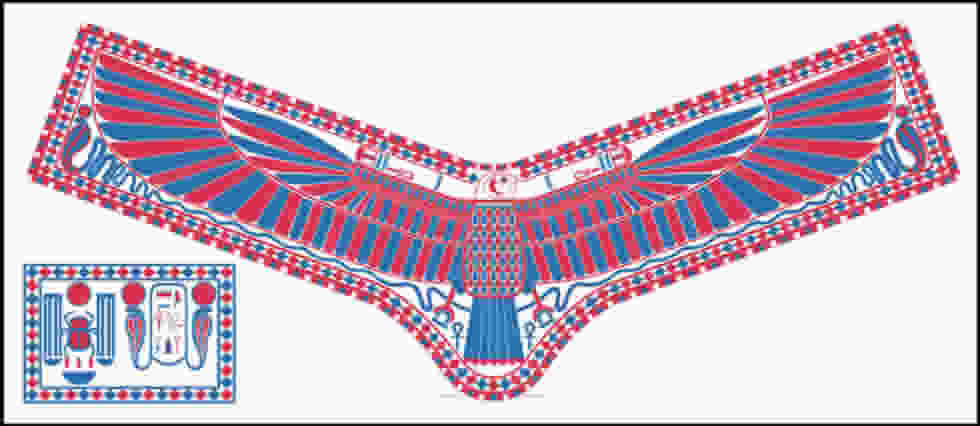
Wings
One of the most mysterious objects encountered during the research of the textiles, were short tubes of linen, with a pair of bird wings attached to it. Carter examined these textiles only shortly and described them in his notes as 'some kind of headgear'.
In many depictions of the pharaoh, protective wings are worn across the chest. In all these cases however, the body of the bird, mostly a falcon, can be seen slightly above the hips. It is unclear how these "falcons" are fastened to the body.
The wings found in the tomb of Tutankhamun were worn in pairs, the body of the birds resting on the shoulders, and with the wings across the chest and back. The tube section was in fact a short sleeve. Most likely the heads, and part of the bodies, of the birds were covered by a collar.
The conventions of the pharaonic art demand a complete as possible depiction of people, animals and objects, and especially important figures as kings, gods and protective birds like the falcon. This explains why these winged garments were shown lower on the body in the paintings and reliefs.


The Mastaba of Ti at Saqqara

  The wall measures 1.55m wide by 4.50m in height, of which the upper 2.75m is decorated. It contains scenes with seventy-four characters di...